

Ouça este podcast gratuitamente no aplicativo: Baixe gratuitamente na App Store
radio.net
Sleeptimer
Guardar rádio
59 episódios
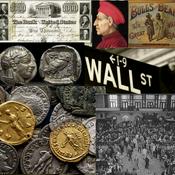
Episode 59. Rome’s Financial Peak and Hidden Cracks (68–180 CE): From Nero to Marcus Aurelius
18/08/2026 | 1h 49minSend us Fan Mail
Rome didn’t just conquer with legions. It conquered with cash flow, credibility, and contracts and then it quietly broke the very engine that paid for its golden age. We walk through the most consequential 112 years in Roman financial history, from Nero’s aftermath to Marcus Aurelius, to see how the Pax Romana becomes an economic peak that’s already hiding its fault lines.
We start with 69 CE, when the imperial throne behaves like a distressed asset and the Praetorian Guard charges a “transaction fee” for loyalty. From there, Vespasian shows up as an accountant in chief, rebuilding the treasury with audits, restored taxes, reclaimed public land, and the infamous urine tax that gives us “money doesn’t stink.” Then Vesuvius freezes time and accidentally preserves real Roman banking records, revealing deposit accounts, book transfers, collateralized loans, auction credit, and maritime finance that would feel familiar to anyone in modern banking or trade finance.
From Domitian’s hard-money credibility play to Trajan’s Dacian gold windfall and the resource curse, we track how empires spend booms, manage trade deficits, and justify luxury imports while depending on customs duties. Hadrian flips the model by ending expansion, then does a dramatic debt write-off by burning tax arrears. Antoninus Pius banks a historic surplus through boring cost discipline, only for Marcus Aurelius to face the ultimate stress test: the Antonine Plague, frontier wars, shrinking tax rolls, and the decision to debase silver in a true emergency.
If you like history that maps cleanly onto today’s arguments about debt forgiveness, inflation, central bank credibility, and bubble psychology, hit subscribe, share this with a friend who loves money and history, and leave a five-star review.
Support the show
To support the podcast through Patreon https://www.patreon.com/HistoryOfMoneyBankingTrade
Visit us at https://moneybankingtrade.com/
Visit us on YouTube https://www.youtube.com/@MoneyBankingTradeEpisode 58. The Architect, the Steward, and the Showman — Augustus, Tiberius, Caligula, Nero, and the Debasement That Started It All
28/07/2026 | 58minSend us Fan Mail
Nero is famous for fire and scandal, but his most lasting move is quieter: he changes the denarius. We follow the early Roman Empire from Augustus’s careful fiscal rebuild to the moment Nero discovers a tool every government eventually confronts the temptation to fund today by shaving value from tomorrow. If you’ve ever wondered how inflation really starts, why “money printing” keeps showing up in crises, or how trust makes currency work, Rome gives you a clean first draft.
We start with Augustus, who inherits a financial disaster and responds like an operator, not a conqueror: fewer legions, tighter taxation, standardized coinage, and a treasury that can finally breathe. Then Tiberius runs the system like a hard-nosed CFO, hoarding cash until a credit crunch forces him to push liquidity back into the economy in a way that looks eerily like an ancient prototype of quantitative easing. Along the way, we map the everyday infrastructure of Roman finance, from forum money changers to temple safekeeping, and ask the big question: is money a commodity or an IOU backed by social trust?
Caligula’s spending spree shows how fast reserves can evaporate, Claudius proves stability can return without wrecking the currency, and then Nero flips the table. By reducing the silver content of the denarius, he creates seigniorage as a hidden tax, triggers the logic behind Gresham’s Law, and sets a precedent that echoes forward through the US Coinage Act of 1965, the Nixon shock, and modern central banking. Subscribe for more history that explains the financial world you live in, and if this helped you see money differently, share the episode and leave a five-star review.
Support the show
To support the podcast through Patreon https://www.patreon.com/HistoryOfMoneyBankingTrade
Visit us at https://moneybankingtrade.com/
Visit us on YouTube https://www.youtube.com/@MoneyBankingTradeEpisode 57. Two Roman Stories: A Credit Crunch and Volcanic Explosion
07/07/2026 | 52minSend us Fan Mail
Rome didn’t just build roads and legions, it built a credit machine. And in 33 CE, that machine seized up in a way that feels painfully familiar: a property crash, a liquidity freeze, bank failures, panic hoarding, and a government rescue that reads like an early draft of modern central banking.
We start by pulling apart the mechanics of Roman finance, from deposits and loans to the Temple of Janus, Rome’s answer to Wall Street. Then we use a powerful idea from Enlightenment economist Ferdinando Galiani, who calls interest “the price of anxiety,” to explain why credit booms flip into sudden crises. Under Tiberius, senators quietly become highly leveraged moneylenders, profiting from an ancient carry trade. When long-neglected rules tied to Julius Caesar’s credit laws are enforced again, lenders rush to comply, loans get called in, land gets dumped, collateral values collapse, and the entire system spirals into a textbook doom loop. The parallels to 2008 are not abstract, they’re structural.
Then we pivot to the ash-buried world of Pompeii and Herculaneum. A remarkable discovery of wooden banking tablets near Pompeii reveals sophisticated commercial banking, commodity-backed lending, and supply chains tied to the Alexandrian grain trade. The eruption of Mount Vesuvius in 79 CE doesn’t just destroy cities, it erases a thriving economic ecosystem overnight, leaving behind haunting evidence of what people do when money and survival collide.
If you like economic history, financial crises, systemic risk, and the hidden plumbing of banking, subscribe, share this with a friend, and leave a review so more people can find the show. What part of Rome’s crisis feels most like our own time?
Support the show
To support the podcast through Patreon https://www.patreon.com/HistoryOfMoneyBankingTrade
Visit us at https://moneybankingtrade.com/
Visit us on YouTube https://www.youtube.com/@MoneyBankingTradeEpisode 56. Rome Becomes Powerful When Its Money Does
16/06/2026 | 45minSend us Fan Mail
Rome is not just marble temples and marching legions. It is benches in the Forum where money changers listen to coins ring, wax tablets that lock in loans, and quiet banking networks that keep grain ships moving and armies paid. Once you look at ancient Roman finance up close, the empire starts to feel less like destiny and more like a set of financial choices, incentives, and constraints.
We walk through what finance actually does, reallocating value through time, spreading risk, directing capital, and scaling trust so bigger transactions can happen. Then we get personal: Cicero’s moralized view of commerce reveals why Roman elites publicly sneer at banking while privately relying on it. That tension sets the stage for Julius Caesar’s debt-fueled rise, the treasury raid that turns state reserves into military operating cash, and coinage reforms that standardize money while making power visible through a living portrait and the gold aureus.
From there, we zoom into the mechanics: counterfeit detection with touchstones and the “ring test,” the market discipline that money changers can impose when rulers debase coinage, and the Publicani system that outsources taxation and infrastructure to investor partnerships. Finally, we use real evidence from wax tablet archives in Puteoli and Pompeii to show Roman banking and trade finance in practice, before landing on Augustus and the tax reforms that create a more predictable imperial revenue base and help enable the Pax Romana.
If you like history of money, banking, and trade that connects everyday transactions to the rise and fall of states, subscribe, share this with a friend, and leave a review so more people can find the show.
Support the show
To support the podcast through Patreon https://www.patreon.com/HistoryOfMoneyBankingTrade
Visit us at https://moneybankingtrade.com/
Visit us on YouTube https://www.youtube.com/@MoneyBankingTradeEpisode 55. The Punic Wars: Rome, Carthage, and Power
26/05/2026 | 1h 11minSend us Fan Mail
Rome and Carthage don’t start as mortal enemies, they start as trading partners signing treaties that quietly reveal who holds real power at sea. From the very first agreement, Carthage looks like the obvious favorite: a Phoenician-descended commercial empire with ships everywhere, deep trade routes, and wealth flowing in from silver and gold. Rome looks local, landlocked by comparison, and boxed into someone else’s maritime rules.
We follow how that imbalance breaks down into the Punic Wars, and why the outcome isn’t just about tactics. You’ll hear how Sicily becomes the spark, how Rome copies Carthaginian ship design, and how the Corvus turns naval combat into the kind of close-quarters fight Roman infantry can win. Then we shift to the real constraint behind every ancient campaign: paying for it. Bronze money floods, costs spiral, and both states face the same brutal problem of wartime finance, from improvised “war bonds” to desperate loans.
The story climaxes with Hannibal’s Spain-backed revival, the Alps crossing, the shock of Trasimene and Cannae, and Rome’s refusal to negotiate even while the treasury collapses. That’s where the denarius enters as a decisive financial technology, and where Iberian silver becomes the strategic prize that changes everything after Scipio’s victories. We close on the uncomfortable lesson Rome learns too late: commerce and credit can rebuild a defeated rival faster than armies can predict, feeding the paranoia that ends with “Carthago Delante Est” and the annihilation of a prosperous city.
If you want more deep history of money, banking, trade, and the financial infrastructure behind empire, subscribe, share this with a friend, and leave a review.
Support the show
To support the podcast through Patreon https://www.patreon.com/HistoryOfMoneyBankingTrade
Visit us at https://moneybankingtrade.com/
Visit us on YouTube https://www.youtube.com/@MoneyBankingTrade
Mais podcasts de História
 Aconteceu com um amigo de um amigo meu • Histórias do RedditHistória
 projeto QuerinoHistória, Sociedade e cultura
 BBC LêHistória
 Fronteiras Invisíveis do FutebolDesporto, Futebol americano, História
 Estação BrasilHistória
 História FMHistória
 The AncientsHistória
 Estranha HistóriaHistória
 The Rest Is HistoryHistória
 História PretaDocumentário, Ensino, História, Sociedade e cultura
Podcasts em tendência em História
 Il podcast di Alessandro Barbero: Lezioni e Conferenze di StoriaEnsino, História, Sociedade e cultura
 Qui si fa l'ItaliaDocumentário, História, Sociedade e cultura
 MemóriaHistória
 Strange ArrivalsDocumentário, História, Sociedade e cultura
 After Dark: Myths, Misdeeds & the ParanormalCrimes verdadeiros, História, Sociedade e cultura
 Alessandro Barbero Podcast - La StoriaArte, História, Livros, Sociedade e cultura
 First AmericaDocumentário, História, Notícias, Política, Sociedade e cultura
 歴史を面白く学ぶコテンラジオ (COTEN RADIO)História
 The Rest Is ClassifiedHistória
 History DailyHistória
 Everything Everywhere Daily: History, Science, Geography & MoreEnsino, História
 The History of RomeEnsino, História
 Easy Money: The Charles Ponzi StoryCrimes verdadeiros, Documentário, História, Sociedade e cultura
 Trashy DivorcesComédia, História
 História e SociedadeHistória
 LingListen 🎧 聆聽História
 Romance of the Three Kingdoms PodcastArte, História, Livros
 Not Just the TudorsHistória
 Documentales TV -Historia y FicciónDocumentário, História, Sociedade e cultura
 Crowned & CancelledHistória, Relacionamentos, Saúde e fitness, Sexualidade, Sociedade e cultura
 Roma Nua & CruaHistória
 Ask Haviv AnythingHistória
Sobre History of Money, Banking, and Trade
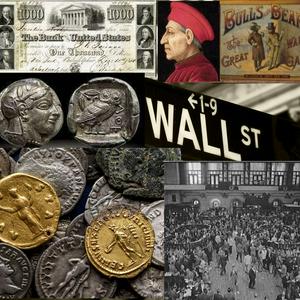
A historical look at the development and evolution of money, banking, and trade. From the ancient civilizations to the present.
Site de podcastOuça History of Money, Banking, and Trade, Aconteceu com um amigo de um amigo meu • Histórias do Reddit e muitos outros podcasts de todo o mundo com o aplicativo o radio.net
Obtenha o aplicativo gratuito radio.net
- Guardar rádios e podcasts favoritos
- Transmissão via Wi-Fi ou Bluetooth
- Carplay & Android Audo compatìvel
- E ainda mais funções
Obtenha o aplicativo gratuito radio.net
- Guardar rádios e podcasts favoritos
- Transmissão via Wi-Fi ou Bluetooth
- Carplay & Android Audo compatìvel
- E ainda mais funções

History of Money, Banking, and Trade
Leia o código,
baixe o aplicativo,
ouça.
baixe o aplicativo,
ouça.
History of Money, Banking, and Trade: Podcast do grupo
 Brasil