

Ouça este podcast gratuitamente no aplicativo: Baixe gratuitamente na App Store
radio.net
Sleeptimer
Guardar rádio
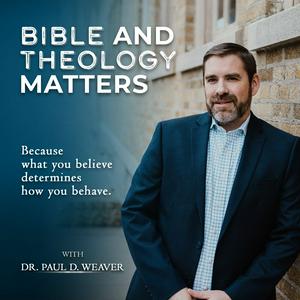
Bible and Theology Matters: Insightful Conversations with Bible Scholars
Dr. Paul D. Weaver - DTS Professor and Biblical Scholar
Último episódio
212 episódios
BTM 210- Part 2: Literary Devices or Historical Revision?| Genre Criticism Examined
10/09/2026 | 37minDid the Gospel writers change historical events to make a theological point? Or can the differences between the Gospels be explained through normal historical reporting and paraphrase?
In Part 2 of this discussion on genre criticism, Dr. Paul Weaver continues his conversation with Dr. Lydia McGrew about the growing debate over how Christians should understand the Gospel accounts—and particularly the claim that the Gospel writers used “literary devices” to reshape or relocate historical events.
Dr. McGrew challenges approaches that explain Gospel differences by appealing to compositional techniques such as displacement, arguing that some proposed “literary devices” go beyond ordinary paraphrase. She also addresses questions surrounding Jesus’ “I am” sayings, the Gospel of John, harmonization, eyewitness differences, and the historical reliability of Scripture.
In this episode, they discuss:Whether Jesus’ “I am” sayings in John should be understood as historical
“Before Abraham was, I am” and “I and the Father are one”
The relationship between the Gospel of John and the Synoptic Gospels
What counts as legitimate paraphrase—and what goes beyond it
Whether Gospel differences require literary or compositional explanations
Why Christians should not be afraid of harmonizing the Gospels
How apparent contradictions can sometimes support rather than undermine eyewitness independence
Why Christians should critically engage with fellow Christian scholars
The danger of dismissing arguments through labels such as “hyper-conservative” or “fundamentalist”
What the early Church Fathers believed about the historical nature of the Gospels
How Christians can grow in confidence in the reliability and historicity of the Gospel accounts
McGrew's central encouragement is not simply to take one scholar's word over another, but to read the arguments, examine the evidence, define terms carefully, and think critically.
If the historical reliability of the Gospels matters to you, this is an important conversation about how we interpret Gospel differences—and what is at stake when we explain them.
Watch Part 2 of this conversation and join the discussion.BTM 209- Part 1: What is the Greatest Threat to Modern Evangelicalism?| Genre Criticism and the Gospels with Dr. Lydia McGrew
04/09/2026 | 51minIn this first part of a two-part conversation, Dr. Paul Weaver speaks with Dr. Lydia McGrew about one of the most important—and controversial—issues facing the evangelical church: genre criticism and its implications for the historical reliability of the Gospels.
What happens when we interpret Matthew, Mark, Luke, and John through the lens of literary conventions and Greco-Roman biography? Did the Gospel writers rearrange events or alter historical details for literary purposes? And where is the line between legitimate literary technique and changing what actually happened?
In this episode, they discuss:Genre criticism and how it is being applied to the Gospels
The Gospels as Greco-Roman biographies (bioi)
Literary devices, authorial intent, and historical accuracy
Whether Gospel writers rearranged events or changed details
The relationship between genre criticism and biblical inerrancy
Why these questions matter for Gospel reliability and Christian confidence in Scripture
Dr. Lydia McGrew is an analytic philosopher specializing in epistemology and the historical reliability of the New Testament. She is the author of Hidden in Plain View, The Mirror or the Mask, The Eye of the Beholder, and Testimonies to the Truth.
Watch Part 1 now, and join us for Part 2 as the conversation continues. If you find this discussion helpful, share it with someone who wants to think more deeply about the reliability of the Gospels and the authority of Scripture.
Subscribe to Bible & Theology Matters for more conversations about Scripture, theology, apologetics, and the truth of Christianity.
Because what you really believe determines how you really behave.BTM 209- Part 1: Are the Four Gospels Reliable?| Genre Criticism and the Gospels with Dr. Lydia McGrew
03/09/2026 | 49minDid Matthew, Mark, Luke, and John rewrite or reshape the history of Jesus? Did the Gospel writers rearrange events, alter details, or even create scenes that never actually happened?
These are some of the challenging claims being made in contemporary New Testament scholarship—and they raise an important question for Christians: Can we trust the Gospels as historically reliable accounts of the life of Jesus?
In this episode of the Bible and Theology Matters Podcast, Dr. Paul Weaver is joined by Dr. Lydia McGrew, an analytic philosopher and prominent defender of the historical reliability of the New Testament and the Gospels.
Dr. McGrew explains her journey from philosophy and formal epistemology into New Testament studies and discusses why she became increasingly concerned about scholarly approaches to the Gospels that, in her view, undermine their historical reliability.
The conversation focuses particularly on genre criticism, Greco-Roman biography (bioi), compositional devices, authorial intent, eyewitness testimony, undesigned coincidences, and biblical inerrancy.
Dr. McGrew challenges the idea that the Gospel writers intentionally changed historical facts for theological or literary purposes. She argues that there is an important difference between ordinary figures of speech—such as hyperbole—and what she calls fact-changing literary devices, in which an author knowingly presents something as having happened when he believes it did not.
One example discussed is the Gospel of John and Jesus' statement, "I thirst." Another is the location and timing of the temple cleansing and the claim that Luke deliberately relocated events geographically.The discussion also asks a crucial question: Where does legitimate literary analysis end and historical revision begin?
In this episode, you'll discover:
What genre criticism is and how it is being applied to the Gospels
What scholars mean by Greco-Roman bioi or ancient biography
Whether identifying the Gospels as Greco-Roman biographies strengthens or limits their historical reliability
The difference between intrinsic and extrinsic genre
Why authorial intent matters when interpreting Scripture
What compositional devices are and why Dr. McGrew challenges their application to the Gospels
The difference between ordinary figures of speech and fact-changing literary devices
Whether the Gospel writers deliberately changed the order or details of historical events
The significance of Jesus saying "I thirst" in the Gospel of John
The debate over the cleansing of the temple in John 2
The question of whether Luke relocated events from Galilee to Jerusalem
Why undesigned coincidences can provide evidence for eyewitness testimony
How internal details in the Gospels can support their historical reliability
Why the historical reliability of the Gospels matters for Christian faith and apologetics
Whether Christians need specialized academic knowledge to understand what the Gospels are communicating
How genre criticism may affect pastors, preaching, and confidence in the biblical text
The relationship between biblical inerrancy, historical reliability, and interpretation
Why Christians should carefully evaluate scholarly arguments rather than simply accepting claims based on academic credentials
Why Does This Matter?
This discussion is ultimately about more than literary theory.If the Gospels are intended to communicate genuine historical events, but we are told that the Gospel authors routinely changed facts, relocated events, or created scenes while presenting them as history, that has significant implications for what Christians can know about the life, ministry, death, and resurrection of Jesus.
As Dr. McGrew explains, the question is not whether the Gospel writers used literary techniques. Scripture clearly contains different genres and figures of speech. The more important question is whether those techniques include deliberately changing historical facts while leaving readers with the impression that those events actually occurred.
This episode invites listeners to examine those claims carefully and to consider the evidence for the historical trustworthiness of the Gospels.If you are interested in New Testament reliability, biblical inerrancy, Gospel historicity, Christian apologetics, genre criticism, eyewitness testimony, or how scholars interpret the Gospels, this conversation is for you.
About Dr. Lydia McGrew
Dr. Lydia McGrew is an analytic philosopher who specializes in formal epistemology and the theory of knowledge. She has published extensively in philosophy and has become well known for her work defending the historical reliability of the New Testament and the Gospels.
She is the author of Hidden in Plain View, The Mirror or the Mask, The Eye of the Beholder, and Testimonies to the Truth, works that examine evidence for eyewitness testimony, undesigned coincidences, and the historical reliability of the Gospel accounts.BTM 208- Can a Scientist Believe in Young Earth Creationism? | Dr. Marcus Ross
27/08/2026 | 48minCan you be a serious scientist and still believe Genesis is real history?
In Part 2 of this conversation on the Bible and Theology Matters Podcast, Dr. Paul Weaver continues his discussion with paleontologist and geologist Dr. Marcus Ross about Young Earth Creationism, Genesis, science, biblical authority, and the relationship between faith and scientific research.
How should Christians respond when scientific conclusions appear to conflict with Scripture? Does saying that "the Bible is not a science textbook" mean that Genesis should not be understood as history? And can ancient Near Eastern creation stories help us understand Genesis without becoming the lens through which we interpret it?
Dr. Ross argues that while the Bible is not a modern science textbook, it does make meaningful historical claims about reality. Those historical claims, he explains, can provide important starting points for scientific investigation and the development of scientific models.
In this conversation, Dr. Weaver and Dr. Ross also explore the relationship between ancient Near Eastern literature and Genesis. While comparative studies can provide helpful linguistic and cultural background, they argue that Genesis should ultimately be interpreted according to its own literary and theological context rather than having an external genre imposed upon it.
Dr. Ross also shares his personal journey as a young earth creationist studying geology and paleontology in secular universities. He discusses the challenges he faced, the questions and tensions he encountered, and why he believes rigorous scientific research and confidence in the historical claims of Genesis do not have to be mutually exclusive.
In this episode, you'll discover:
How ancient Near Eastern creation stories can—and cannot—help us understand Genesis
Why Genesis should not simply be interpreted through the lens of Enuma Elish, Gilgamesh, or other ancient texts
What it means to distinguish between "intrinsic" and "extrinsic" genres
How the Bible can make historical claims without functioning as a modern scientific textbook
Why Dr. Marcus Ross believes Genesis provides historical "tie points" for scientific investigation
Can a scientist believe in Young Earth Creationism?
What challenges young earth creationists can face in secular academic settings
How Young Earth Creationism has developed as an area of scientific research
How Christians should approach apparent conflicts between science and Scripture
Why science and theology should both be examined carefully when their conclusions appear to differ
Why Dr. Ross believes Scripture has a unique authority as God's propositional revelation
Resources for Christians who want to explore creation, origins, and Genesis more deeply
For Christians wrestling with questions about creation versus evolution, the age of the earth, Noah's Flood, fossils, geology, biblical inerrancy, science and faith, or the historical reliability of Genesis, this episode offers a thoughtful conversation about how Christians can engage difficult questions without abandoning either intellectual rigor or confidence in Scripture.
🎙️ Listen to Part 1 of this conversation: https://youtu.be/r4OxQ49-qkg
About Dr. Marcus Ross
Dr. Marcus Ross is a paleontologist and geologist who has studied and taught in the fields of geology, paleontology, and origins. He joins Dr. Paul Weaver to discuss the biblical and scientific questions surrounding Young Earth Creationism and the historical interpretation of Genesis.
He is also the CEO of Cornerstone Educational Supply: https://cornerstone-edsupply.com/
Subscribe to Bible and Theology Matters
If you enjoyed this episode, please like, subscribe, leave a review, and share this conversation with someone wrestling with questions about the Bible, theology, science, and creation.BTM 207- Young Earth Creationism Explained: What Does Genesis Really Teach?
20/08/2026 | 51minCan Christians trust the Genesis creation account as real history? Does Genesis 1–11 describe actual events, or should these opening chapters of the Bible be understood primarily as theological literature, myth, or symbolism?
In this episode of the Bible and Theology Matters Podcast, Dr. Paul Weaver is joined by Dr. Marcus Ross, a paleontologist, geologist, former professor of geology at Liberty University, and a prominent voice in the Young Earth Creationism movement. Together, they explore some of the most important questions surrounding Genesis, creation, Adam and Eve, Noah's Flood, biblical history, and the relationship between Scripture and science.
Dr. Ross explains why his commitment to Young Earth Creationism is fundamentally rooted in his interpretation of Scripture and outlines five defining components of the position: a recent creation, six consecutive days of creation, a historical Adam and Eve as the first humans, the cosmic consequences of the Fall, and a global Flood in the days of Noah.
The conversation also examines why the historical nature of Genesis matters for the rest of the biblical story. Dr. Ross and Dr. Weaver discuss the literary and theological richness of Genesis 1–11 while arguing that theological purpose does not require abandoning historical reality. They compare Genesis with other ancient Near Eastern creation stories, consider the mytho-historical approach to Genesis, and explore how Jesus, Paul, and the rest of Scripture treat Adam and the creation account.
In this episode, you'll discover:
What Young Earth Creationism actually teaches
The five key components of a biblical Young Earth Creationist worldview
Why a scientist can maintain confidence in the authority and reliability of Scripture
Whether Genesis 1–11 is history, theology, myth, or a combination of literary genres
Why Genesis can be both historically grounded and theologically purposeful
How Genesis differs from ancient Near Eastern creation accounts
Why the historicity of Adam and Eve matters for Christian theology
What Romans 5, 1 Corinthians 15, Acts 17, and the genealogy of Luke contribute to the discussion
How the first Adam and the "second Adam," Jesus Christ, are connected in the gospel
Why the Fall has consequences that extend beyond Adam and Eve
Whether Noah's Flood should be understood as global or local
How Jesus connects Genesis 1 and Genesis 2 as part of a unified creation account
Why the debate over Genesis affects far more than the age of the earth
At the heart of this conversation is a larger question: Is Genesis the historical foundation of the biblical story? From creation and the Fall to sin, redemption, Israel, and ultimately Jesus Christ, the opening chapters of Genesis provide essential context for understanding the rest of Scripture.
Whether you are wrestling with questions about creation versus evolution, the age of the earth, biblical inerrancy, Adam and Eve, dinosaurs and fossils, Noah's Flood, or how science and the Bible relate, this conversation offers a thoughtful and engaging exploration of why Genesis still matters.
Subscribe to Bible and Theology Matters
If this episode encouraged you, please like, subscribe, leave a review, and share this conversation with someone who is interested in the Bible, theology, creation, and Christian worldview.
The Bible and Theology Matters Podcast exists to help Christians grow in their knowledge of the Word of God and in their relationship with the God of the Word.
Because what you really believe determines how you really behave.
#YoungEarthCreationism #Genesis #Creation #BiblicalCreation #AdamAndEve #NoahsFlood #BibleAndTheologyMatters #ChristianApologetics #BiblicalWorldview #CreationVsEvolution #BiblicalInerrancy #GenesisHistory #MarcusRoss
Mais podcasts de Cristianismo
 O Evangelho em 3 MinutosCristianismo, Religião e espiritualidades
 Frei Gilson Podcast - OficialCristianismo, Religião e espiritualidades
 Hernandes Dias LopesCristianismo, Religião e espiritualidades
 Salve Maria! Seu Podcast CatólicoCristianismo, Espiritualidades, Religião, Religião e espiritualidades
 Bíblia em um anoCristianismo, Religião e espiritualidades
 Padre Pedro Willemsens - MeditaçõesCristianismo, Religião e espiritualidades
 Padre Milton FerreroniCristianismo, Religião e espiritualidades
 Joyce Meyer Desfrutando a Vida Diária®Cristianismo, Espiritualidades, Religião e espiritualidades
 Augustus NicodemusCristianismo, Religião e espiritualidades
 Bibotalk - Todos os podcastsCristianismo, Diários pessoais, Filosofia, Religião e espiritualidades, Sociedade e cultura
Podcasts em tendência em Cristianismo
 ChácaraTalkCristianismo, Religião e espiritualidades
 Café da ManhãCristianismo, Religião e espiritualidades
 O Catecismo em 1 anoCristianismo, Religião e espiritualidades
 The Thomistic InstituteCristianismo, Filosofia, Religião e espiritualidades, Sociedade e cultura
 Teo HayashiCristianismo, Religião e espiritualidades
 I Don't Have Enough FAITH to Be an ATHEISTCristianismo, Ensino, Religião e espiritualidades
 Leandro B. PeixotoCristianismo, Religião e espiritualidades
 BibleProjectCristianismo, Religião e espiritualidades
 Sezar Cavalcante - PregaçõesCristianismo, Religião e espiritualidades
 Elevation with Steven FurtickCristianismo, Religião e espiritualidades
Sobre Bible and Theology Matters: Insightful Conversations with Bible Scholars
The Bible and Theology Matters Podcast is a conversation with Biblical Scholars about all things Bible and Theology, including: challenging issues of Bible interpretation, important theological topics, essential Hermeneutical principles, Bible backgrounds and customs, Biblical ethics and worldview, apologetics, biblical archaeology, and much more. Dr. Paul D. Weaver, Professor and Biblical Scholar at Dallas Theological Seminary is the host.
Site de podcastOuça Bible and Theology Matters: Insightful Conversations with Bible Scholars, O Evangelho em 3 Minutos e muitos outros podcasts de todo o mundo com o aplicativo o radio.net
Obtenha o aplicativo gratuito radio.net
- Guardar rádios e podcasts favoritos
- Transmissão via Wi-Fi ou Bluetooth
- Carplay & Android Audo compatìvel
- E ainda mais funções
Obtenha o aplicativo gratuito radio.net
- Guardar rádios e podcasts favoritos
- Transmissão via Wi-Fi ou Bluetooth
- Carplay & Android Audo compatìvel
- E ainda mais funções

Bible and Theology Matters: Insightful Conversations with Bible Scholars
Leia o código,
baixe o aplicativo,
ouça.
baixe o aplicativo,
ouça.
 Brasil