
Ouça este podcast gratuitamente no aplicativo: Baixe gratuitamente na App Store
radio.net
Sleeptimer
Guardar rádio
342 episódios
S2E366: Live Episode: What Your Child’s Behavior Says About You, with Dr. Shefali Tsabary
13/11/2026 | 1h 12minWhat if parenting is less about raising your child and more about raising yourself? It’s the big idea behind conscious parenting, and in this special live episode recorded in New York in front of a room of Alpha parents, Mackenzie and leading clinical psychologist Dr. Shefali explore how a parent’s fears, ego, and expectations shape the way kids grow up.
Dr. Shefali Tsabary is a clinical psychologist with a doctorate from Columbia University and the New York Times bestselling author of The Conscious Parent. And in this special talk, she explains why your most defiant child may be your greatest teacher, the difference between achievement and performance, what a child’s worst behavior is really trying to tell you, and one simple thing you can do tonight to help your child feel truly known.
The conversation gets personal, and Mackenzie ends up in the hot seat a few times herself, so tune in and enjoy this exclusive live discussion.
Episode Big Ideas
Parenting Is About Raising Yourself: Why every parent starts with a fantasy of who their child will become, and how kids act as a mirror for what we haven’t yet healed.
Where to Begin: Why your biggest pain point (the yelling, the anxiety, the C grade that sets you off) is the doorway in, and how to peel back the fear underneath your reaction.
Mackenzie’s Mirror Moment: How a question from her husband about her daughter’s choices led Mackenzie to realize she was chasing her own ego, and what changed once she let go.
Your Defiant Child Is Your Awakener: Why the “difficult” child pushes parents to grow, and why the “good” child can keep parents stuck in control.
Achievement vs. Performance: How achievement that doesn’t come from the child turns into performance, and how Alpha tries to pair high standards with real ownership and autonomy.
“I Want My Child To...”: Why this sentence is one of the most dangerous a parent can say, and how curiosity about a child’s interests (like video games) can open a better path.
What Behavior Is Really Saying: The three reasons kids act out, why a “scratched lens” explains most parent frustration, and how to see the child beneath the behavior.
Connection Without an Agenda: Why presence matters more than busyness, and a 15-minute practice for being with your child with nothing to teach or fix.
Feeling Known: Why seeing your child in their ordinariness is one of the most powerful things a parent can do.
Episode Timestamps:
00:00 - Introduction: chasing what’s best for our kids vs. what they actually need
01:01 - Dr. Shefali’s opening talk: why we need to reclaim childhood
03:25 - Why every parent was “perfect” until they had a child
08:14 - Your child as a mirror: parenting is about raising you
10:41 - The fantasy every parent brings to parenthood
15:34 - From fixing the child to getting out of the way: the shared mission of Alpha and conscious parenting
18:22 - Ara Katz, a founding Alpha parent, on his son feeling “seen” and the idea of conscious educating
23:01 - Where to begin: start with your biggest pain point
27:36 - Mackenzie’s story: letting her daughters choose their own path
33:15 - Why your defiant child is your greatest teacher
36:26 - High standards with support, and the bagel dough story
38:58 - Achievement vs. performance
45:18 - “I want my child to...”: the most dangerous sentence parents say
47:12 - What a child’s behavior is really saying
48:11 - The three reasons kids act out
50:30 - The “scratched lens” that makes normal kids look like problems
52:12 - When your child breaks the rules: seeing the child beneath the behavior
57:29 - Mackenzie’s dining room table moment
1:02:17 - A 15-minute practice: being with your child with no agenda
1:04:39 - What we inherit from our parents, and what we pass on
1:05:14 - “Hello, ego”: why you can’t out-conscious yourself
1:10:52 - One small thing to help your child feel known
Watch the Future of Education on YouTube: www.youtube.com/@future_of_education
Read MacKenzie’s Substack: www.futureofeducation.substack.com
Learn more about our schools: www.2hourlearning.com/schools
Learn more about Alpha School: www.alpha.schoolS2E365: Is AI Good for Classrooms? 6 Learning Science Principles It Can Help Deliver (A Former Teacher Explains)
06/11/2026 | 46minIs AI going to help students learn better, or is it the worst thing we could put in a classroom? It’s one of the biggest debates in education right now, and Mackenzie makes the case that decades of learning science research point to practices a single teacher in front of a classroom simply can’t deliver at scale.
To dig into it, Mackenzie sits down with Sam DePalo, a former traditional teacher and Alpha guide with over 10 years of classroom experience. A Fulbright scholar with degrees in linguistics, literature, and mathematics, plus a postgraduate focus on neurodiversity and executive function, Sam taught high school math through Teach For America in a Title I public school (with a class of 47 students), then worked in private schools with much smaller class sizes. She saw the same limits in both.
In this conversation, Sam explains six learning science principles and why she believes an AI tutor (not a chatbot) can help deliver them, while freeing teachers to focus on motivating and connecting with kids.
In this episode, we discuss:
Why the Traditional Model Falls Short: How the industrial-era classroom was built to educate the masses, and why Sam saw the same limits in a 47-student Title I class and in small private-school classrooms.
One-to-One Instruction: Why individualized learning is the most powerful principle, and how an AI tutor can assess what a student knows and meet them at the right pace and level.
Mastery-Based Learning: Why moving on before a student has mastered a concept leaves gaps, what a 90% mastery bar looks like, and how grade inflation and the bell curve blur what an “A” really means.
Spaced Repetition and Retrieval Practice: How constantly revisiting past material, and being quizzed on it, beats cramming, and why a teacher with 25+ students can’t realistically build this in for every kid.
The Zone of Proximal Development: How kids shut down when work is too hard or too easy, and why productive struggle (not gamified, easy learning) is the goal.
Cognitive Load Theory: Sam’s “working memory whiteboard” explanation of why shaky math facts get in the way of learning algebra.
The Teacher’s Role: What changes when AI takes on grading, data analysis, and differentiation, so adults can focus on motivation and connection.
Episode Timestamps:
00:00 - The great debate: Is AI good for classrooms or the worst thing for them?
01:37 - Sam’s background: from Fulbright scholar to Teach For America
04:16 - Why learning science doesn’t support the one-teacher model, even in small private schools
07:54 - Learning Science Principle 1: One-to-one instruction
09:08 - How an AI tutor (not a chatbot) makes individualized learning possible
12:36 - Learning Science Principle 2: Mastery-based learning
13:30 - Why Alpha sets the mastery bar at 90%
16:31 - Grade inflation, the bell curve, and the paper that got a 95% without being read
19:06 - Learning Science Principle 3: Spaced repetition and distributed practice
22:49 - Why cramming fails: the accounting class story
24:18 - Learning Science Principle 4: Retrieval practice
28:03 - Standardized assessments as feedback, not high-stakes judgment
30:00 - Hole-filling in action: how a student went from a 720 to a 790 on SAT math
32:12 - Learning Science Principle 5: The zone of proximal development
36:02 - Productive struggle vs. gamified learning
37:21 - Learning Science Principle 6: Cognitive load theory
41:19 - Why a motivated student matters most
43:13 - What AI frees teachers to do
Watch the Future of Education on YouTube: www.youtube.com/@future_of_education
Read MacKenzie’s Substack: www.futureofeducation.substack.com
Learn more about our schools: www.2hourlearning.com/schools
Learn more about Alpha School: www.alpha.schoolS2E364: Are You Coddling Your Kid? Signs and Fixes From a Veteran Educator
30/10/2026 | 23minOverprotectiveness often stems from good intentions, but it can unintentionally strip children of the confidence, problem-solving skills, and resilience they need to thrive. In this episode of The Future of Education, Mackenzie speaks with Eric Salgado—an educator with over two decades of experience as a teacher, principal, school-system director, and Alpha School guide—about how to spot overprotection and replace it with high-support frameworks.
Eric details the subtle classroom signs of overparenting, explains how to implement the "1% better every day" mindset at home, and breaks down why holding firm boundaries with natural consequences builds genuine independence.
Key Topics Covered
Spotting Coddling in Real Time: Telltale behavioral signs of overprotection in school.
High Standards, High Support: Balancing firm boundaries with empathetic mentorship.
The "1% Better Every Day" Mindset: Helping children replace perfectionism with positive micro-habits.
Tactical Routines for Independence: Practical strategies for fixing stressful morning wake-ups, handling forgotten sports gear, and using pre-departure checklists.
Building Teacher-Parent Partnerships: How parents and educators can collaborate as a unified team to mentor the whole child.
Episode Timestamps
00:00 - Defining Coddling: Overprotection & Telltale Signs
01:56 - Helicopter Parenting & Classroom Behavioral Cues
04:27 - High Standards + High Support: The Mentor Model
06:38 - Outsourcing High Standards & Partnering with Educators
08:39 - The "1% Better Every Day" Mindset Explained
11:21 - Case Study: How Small Wins Unlocked a Struggling Student
16:26 - Setting Boundaries: Morning Routines & No Empty Threats
19:20 - Building Daily Independence in Young Children
21:07 - The Forgotten Sports Gear Test: Letting Kids Face Consequences
22:33 - Building a Unified Parent-Teacher Partnership
Watch the Future of Education on YouTube: www.youtube.com/@future_of_education
Read MacKenzie's Substack: www.futureofeducation.substack.com
Learn more about our schools: www.2hourlearning.com/schools
Learn more about Alpha School: www.alpha.schoolS2E363: How to Be a Mentor to Your Kid (Not Just a Parent)
23/10/2026 | 38minMany parents worry about whether their kids are developing the character, resilience, and adaptability needed for a fast-changing world. In this episode, Mackenzie sits down with Chauncey—a former Teach for America core member, NYC Department of Education leader, Goldman Sachs talent executive, and current Alpha School guide. Chauncey shares how combining high standards with high support creates the ultimate mentor mindset, and how parents can bring these exact frameworks into their homes.
Chauncey breaks down why most life lessons are "caught, not taught," how to decouple age from learning stage so kids master concepts without shame, and practical ways parents can step into their child’s world to unlock quiet or anxious kids.
Episode Timestamps
03:28 - Chauncey’s Journey: Teach for America, Penn, Dept of Ed & Goldman Sachs
08:08 - Why AI Education Is 90% Human Mentorship, 10% Technology
09:02 - The "Big Game" vs. "Little Games": Raising Kids with Character
11:57 - Transitioning from Traditional Teaching to the Mentor Model
13:59 - Lessons Are Caught, Not Taught: The Mirror Loop for Parents
15:33 - The "Glows, Grows & Everyone Should Know" Daily Framework
18:31 - How Taking Immediate Ownership Neutralizes Conflict
20:04 - "Love of School Is Love of Life": Making Daily Routines Joyful
22:50 - High Standards + High Support: Why Kids Crave Real Challenges
26:18 - Decoupling Age and Stage: Eliminating Academic Shame in Kids
31:20 - How to Step Into the World of a Quiet or Anxious Child
34:09 - Bringing World-Class Educational Innovation to a Billion Kids
Watch the Future of Education on YouTube: www.youtube.com/@future_of_education
Read MacKenzie's Substack: www.futureofeducation.substack.com
Learn more about our schools: www.2hourlearning.com/schools
Learn more about Alpha School: www.alpha.schoolS2E362: Is Your Kid's School Teaching Reading Wrong? 5 Non-Negotiables from a Curriculum Expert
16/10/2026 | 44minNational reading scores are plummeting, yet many schools are still using reading programs that completely ignore basic learning science. In this episode, Mackenzie sits down with curriculum expert and learning scientist Karen Vaites to unpack the national literacy crisis and expose what most schools get wrong about teaching kids to read.
Karen unveils the 5 non-negotiables every parent must evaluate their child’s elementary reading curriculum for. She exposes why traditional classrooms are failing young readers and gives parents an actionable 5-step checklist—covering phonics, progress screening, knowledge-building, reading volume, and writing—to ensure their child gets the reading education they deserve.
Episode Timestamps:
00:00 - The National Literacy Crisis & Guest Introduction
01:12 - Why Early Reading Is the Tailwind for All Academic Success
02:51 - What’s Driving the Reading Decline? Screens & School Distractions
05:23 - Science of Reading vs. Faddish Classroom Methods
08:08 - The Cricket Passage Test: Why Background Knowledge Drives Comprehension
12:38 - The "Southern Surge": How Mississippi & Louisiana Turned Scores Around
15:37 - Phonics vs. Whole Language: How Kids Actually Learn the English Code
22:44 - Non-Negotiable 1: Phonics (What to Look For)
25:43 - Non-Negotiable 2: Third-Party Screening
27:38 - K–2 Milestones: When Should Parents Actually Worry?
30:14 - Non-Negotiable 3: Knowledge-Building Curricula
33:21 - Non-Negotiable 4: High Volume of Reading Full Books
34:00 - Non-Negotiable 5: Integrated Daily Writing
34:30 - What Parents Can Do at Home to Safeguard Literacy
37:08 - Next-Gen Tools: Alpha Phonics & Science-Backed Learning
38:34 - Decoding Irregular Words
41:39 - Debunking the Biggest Literacy Myth in American Education
Resources & Links Mentioned
UFLY (University of Florida Literacy Institute): www.ufli.education.ufl.edu/
Teach Your Child to Read in 100 Easy Lessons: https://a.co/d/0j64tHNY
The Knowledge Matters Campaign: https://knowledgematters.org/
Watch the Future of Education on YouTube: www.youtube.com/@future_of_education
Read MacKenzie's Substack: www.futureofeducation.substack.com
Learn more about our schools: www.2hourlearning.com/schools
Mais podcasts de Crianças e família




Podcasts em tendência em Crianças e família
















Sobre Future of Education Podcast
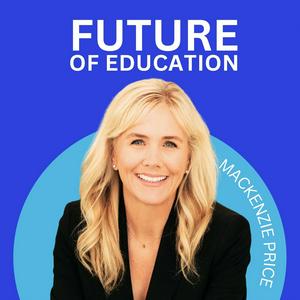
The Future of Education Podcast is the place to find out what's happening in schools. Our guests are wide and varied, from educators, entrepreneurs, athletes, celebrities, influencers and most importantly-our students! They all have one thing in common- they are passionate about reinventing education to make it relevant and efficient. Our host, MacKenzie Price, is the Co-Founder of 2hr Learning (2hourlearning.com) and some of the top-performing schools in the country. 2 Hour Learning is a groundbreaking school model that is reshaping the landscape of K-12 education. It's powered by AI technology, enabling schools to provide personalized curriculum to students. Our K-12 schools perform in the top 2% nationwide by leveraging this personalize model to help students love school, learn twice as much, and build life skills. MacKenzie is at the forefront of educational transformation, striving for a balanced and enriching learning experience for every child. She graduated with a BA in Psychology from Stanford University and resides in Austin, Texas, with her husband and two daughters. The Future of Education podcast is produced by 7 Lyons Media (7LyonsMedia.com). Please send press inquiries to mkp@2hourlearning.com.
Site de podcastOuça Future of Education Podcast, A Mary Conta - Hora de Dormir e muitos outros podcasts de todo o mundo com o aplicativo o radio.net
Obtenha o aplicativo gratuito radio.net
- Guardar rádios e podcasts favoritos
- Transmissão via Wi-Fi ou Bluetooth
- Carplay & Android Audo compatìvel
- E ainda mais funções

Future of Education Podcast: Podcast do grupo
 Brasil

