
Ouça este podcast gratuitamente no aplicativo: Baixe gratuitamente na App Store
radio.net
Sleeptimer
Guardar rádio
104 episódios
S7E3: Escape from the World-Island: Geopolitics and Geoeconomics
20/10/2026 | 36minProfessor Scott Smitson traces the origins of geopolitics and geoeconomics as concepts and why these forgotten ideas are returning to shape today's world.
The triumphalism following the end of the Cold War led some to believe we had reached The End of History, and that great powers had moved beyond a world shaped by geopolitics and geoeconomics. Robert Kaplan's The Revenge of Geography in 2012 challenged this view, arguing that geography still shapes how states see the world, and can either strengthen them or limit their ambitions. This is the core of geopolitics, an idea developed in the late 19th and early 20th centuries by thinkers such as Rudolf Kjellén and Sir Halford Mackinder.
Drawing on the achievements of the Mongol Empire – see our discussion of its chief strategist, Subotai, in Season 4, Episode 1 – Mackinder believed that whoever rules the Heartland (Eurasia), commands the 'World Island' and thus the world. This was problematic for maritime powers, and later Nicholas Spykman argued that it was actually whoever controlled the Rimland, the coastal regions surrounding Eurasia, who controlled the destinies of the world. This was reflected in George Kennan's logic behind the Cold War containment strategy toward the Soviet Union. Its legacy remains in thinking about China, but does the Belt and Road Initiative suggest an attempt by China to break out of this singular characterisation and reduce its vulnerability to classical containment?
Professor Scott Smitson is Director of the Grand Strategy Program at Denison University in Granville, Ohio. He served for 21 years in the US Army, including as a strategist at US Central and Southern Commands and the Joint Staff. Has also served for a period as a US Officer embedded in the UK's Ministry of Defence Strategic Plans team.
Further Reading:
Nicholas J. Spykman, Geography of the Peace, Harcourt, Brace & Co., 1944.
Halford Mackinder, 'The Geographical Pivot of History', The Geographical Journal, Vol. 23, No. 4, April 1904, pp. 421–437. Available at: https://dn720002.ca.archive.org/0/items/The-geographical-pivot-of-history/The%20Geographical%20Pivot%20of%20History%20by%20Halford%20John%20MacKinder.pdf
Robert D. Kaplan, The Revenge of Geography: What the Map Tells Us About Coming Conflicts and the Battle Against Fate, Random House, 2012. Available at: https://archive.org/details/TheRevengeOfGeographyWhatTheMapTellsUsAboutComingConflictsAndTheBattleAgainstFate
Robert D. Blackwill and Jennifer M. Harris, War by Other Means: Geo-economics and Statecraft, Harvard University Press, 2017. Available at: https://archive.org/details/warbyothermeansg0000blac
US Air Force, China Aerospace Studies Institute, In Their Own Words: Science of Military Strategy 2020, January 2022. Available at: https://www.airuniversity.af.edu/Portals/10/CASI/documents/Translations/2022-01-26%202020%20Science%20of%20Military%20Strategy.pdf
Related RUSI Talking Strategy Episodes
S1E1, Sir Julian Corbett and the British Way of War, with Professor Andrew Lambert.
S1E4, Leo VI (the Wise) and the Beginning of Western Strategy, with Dr Georgios Chatzelis
S1E5, Admiral Liu Huaqing and China's Island Chain Strategy, with Professor Christopher Yung.
S2E2, Neptune's Prophet: Alfred Thayer Mahan, with Cdr Dr Benjamin Armstrong.
S5E13, Modernising the Royal Navy: Admiral Lord Fisher, with Dr Richard Dunley
S5E18. George C Marshall: Strategic Planning for War and Peace, with Professor Bill Johnsen.S7E2: What Does a Return to Realpolitik Mean? With Professor John Bew
06/10/2026 | 33minWhat is realpolitik, and why is the world said to be returning to it? Professor John Bew CMG traces the idea back to its origins.
The world may well be entering a new age of realpolitik, but the harder question is defining which kind. The term is usually associated with an unsentimental use of power to further national interests, often seen as a rejection of a more idealistic, values-based approach to international relations. But that's not where it came from. Realpolitik was first coined in 1853 by Ludwig von Rochau, a German liberal, who used it to describe something different: the ability to understand and adapt to the realities of power, and to pursue enlightened goals in a world that doesn't follow enlightened rules. For von Rochau, Realpolitik wasn't just about foreign policy – the strongest states, he argued, were those that could harness social forces at home and manage internal division effectively.
Professor John Bew is a historian at King's College London and a leading figure at the Centre for Statecraft and National Security. He has advised four British Prime Ministers and authored three UK National Security Strategies. His book, Realpolitk: a History is a definitive work on the subject, just as are his biographies on Castlereagh and Attlee.
Further reading:
John Bew, Realpolitik: A History (Hurst, 2026).
Henry Kissinger, Diplomacy (Simon & Schuster, 1994).
Henry Kissinger, A World Restored: Metternich, Castlereagh and the Problems of Peace, 1812–22 (Weidenfeld & Nicolson, 1999).S7E1: Avoiding Strategic Surprise: Lessons from NATO with Dr Florence Gaub
22/09/2026 | 32minNATO expert Dr Florence Gaub explains how strategic foresight helps NATO anticipate and avoid strategic surprise in an uncertain world.
Strategic surprise happens when new information fundamentally changes how we see the world. In an increasingly uncertain global landscape, predicting exact outcomes is nearly impossible – and that unpredictability heightens the risk of surprise. Yet as Lord Mervyn King explored in Season 6, genuine 'Black Swan' events – to quote Nicholas Taleb – are rarer than we think. Dr Florence Gaub describes how we can use strategic foresight to anticipate possible – even if unlikely – futures and avoid being caught off guard. She cautions, however, that it is not enough to 'think the unthinkable', futurologists also need to have their voice heard and acted on by those in power, so the work has to straddle both creative thinking and engaging with bureaucracies.
Dr Florence Gaub is the Director of the Research Division at the NATO Defence College having previously worked at the European Union Institute for Security Studies. Her PhD in international politics is from Humbolt University. She is the author of Future, a User's Guide, a graphic novel for NATO called NATO, 2099, and editor of What If…?: Ten Dragon King Scenarios for 2030, which was published at the NATO Defence College in 2025.
Further Reading
Florence Gaub, Future, a User's Guide, Hurst, 2026.
Florence Gaub, NATO, 2099: A Graphic Novel, NATO, 2024
Florence Gaub (ed.), What If…?: Ten Dragon King Scenarios for 2030, NATO Future Series, November 2025
Florence Gaub and Jonathan Heist, 'NATO's Permanent Crisis', Foreign Affairs, 16 June 2026.
Philip Tetlock and Dan Gardner, Superforecasting: The Art and Science of Prediction, Random House, 2015.
Related RUSI Talking Strategy Episodes
Talking Strategy, Season 3, Episode 6 – Net Assessment as a Tool of Strategy, with Andrew Marshall and Dr Thomas Mahnken. RUSI.
Talking Strategy, Season 4, Episode 14 – Evolving, Adopting and Adapting Alliance Strategy, with Lord Peach. RUSI.
Talking Strategy, Season 5, Episode 1 – Leading a Defence Start-up: NATO's First Secretary General, Lord Ismay, with Lt Gen Sir John Kiszely. RUSI.
Talking Strategy, Season 6, Episode 3 – Effective Strategy for Radical Uncertainty, with Lord Mervyn King. RUSI.S6E22: Delivering National Security Strategies
14/07/2026 | 38minFormer UN Ambassador and National Security Advisor Sir Mark Lyall Grant discusses the challenges facing delivery of Western security strategies.
In this season of Talking Strategy we have explored many of the key themes of today's security and defence strategies, but the test of a strategy is what changes as a result. A perfectly written strategy that makes the wrong assumptions, or that cannot be delivered, is meaningless at best, and often worse. In the final episode of this season, we examine the vital question of how defence strategy is delivered.
With so many Western strategies built on the assumption of a rules based international order, the fracturing of that system poses profound challenges for our defence strategies. Sir Mark, who chaired the UN Security Council four times, describes how the assumption was perhaps overblown – based on a 'Golden Age' that only lasted for 25 years – and how the world is moving in a disorderly manner towards a three-tier model in which interests are enforced through power.
In this new world, governments need to confront the reality that they cannot guarantee the safety of their citizens alone or without the help of their populations. This affects how governments operate – their structures and processes – and the conversations they need to have with their people and allies.
Further Reading
Mark Lyall Grant, 'The world order in crisis', Horizons: Journal of International Relations and Sustainable Development, vol.21 (2022): 124-133.
Peter Ricketts, Hard Choices: The Making and Unmaking of Global Britain, Atlantic Books, 2021.
Jack Watling, Statecraft: The New Rules of Power in a Divided World, Macmillan, 2026.S6E21: Dr Jack Watling on Ukrainian Adaptation to War
30/06/2026 | 33minIn our 100th episode, we talk to RUSI senior research fellow Dr Jack Watling about the transformation in Ukraine in response to Russia's War.
Against what many considered a materially superior adversary, Ukraine has not only withstood Russian aggression, but has fought back with courage, ingenuity and commitment from the whole of society. We discuss how it has achieved this, not just through the armed forces, but in mobilising its people and industry. We also consider what lessons there are for others facing the threat of modern war.
Dr Jack Watling is one of the UK's foremost commentators on Russia's war in Ukraine. The author of Statecraft: The New Rules of Power in a Divided World and co-author of the RUSI paper Tactical Developments During the Third Year of the Russo-Ukrainian War, his analysis of the war is highly prized by many governments.
Further Reading
Jack Watling, Statecraft: The New Rules of Power in a Divided World, MacMillan, 2026.
Jack Watling, Oleksandr Danylyuk and Nick Reynolds, Preliminary Lessons from Ukraine's Offensive Operations, 2022-2023, RUSI, 2024.
Jack Watling and Nick Reynolds, Tactical Developments During the Third Year of the Russo-Ukrainian War, RUSI, 2025.
Siddarth Kaushal & Paul O'Neill (eds.), The Role of Dissimilar Rearmament in Allied Deterrence, RUSI Whitehall Paper 102, 2025.
Mais podcasts de História







Podcasts em tendência em História
















Sobre Talking Strategy
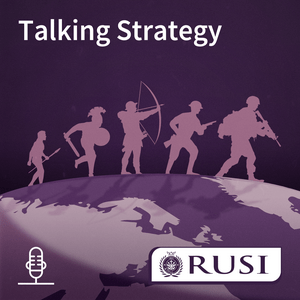
Our thinking about defence and security is shaped by ideas. What we see depends on our vantage point and the lenses we apply to the world. Governments, military and business leaders are seeking to maximise the value they gain from scarce resources by becoming more 'strategic'. Standing on the shoulders of the giants of strategy from the past helps us see further and more clearly into the future. This series is aimed at those looking to learn more about strategy and how to become more strategic – leaders, practitioners and scholars.
This podcast series, co-chaired by Professor Beatrice Heuser and Paul O'Neill, examines the ideas of important thinkers from around the world and across the ages. The ideas, where they came from and what shaped those whose ideas shape us now. By exploring the concepts in which we and our adversaries think today, the episodes will shine a light on how we best prepare for tomorrow.
The views or statements expressed by guests are their own and their appearance on the podcast does not imply an endorsement of them or any entity they represent. Views and opinions expressed by RUSI employees are those of the employees and do not necessarily reflect the view of RUSI.
Site de podcastOuça Talking Strategy, projeto Querino e muitos outros podcasts de todo o mundo com o aplicativo o radio.net
Obtenha o aplicativo gratuito radio.net
- Guardar rádios e podcasts favoritos
- Transmissão via Wi-Fi ou Bluetooth
- Carplay & Android Audo compatìvel
- E ainda mais funções
Obtenha o aplicativo gratuito radio.net
- Guardar rádios e podcasts favoritos
- Transmissão via Wi-Fi ou Bluetooth
- Carplay & Android Audo compatìvel
- E ainda mais funções

Talking Strategy
Leia o código,
baixe o aplicativo,
ouça.
baixe o aplicativo,
ouça.
Talking Strategy: Podcast do grupo
 Brasil