
Ouça este podcast gratuitamente no aplicativo: Baixe gratuitamente na App Store
radio.net
Sleeptimer
Guardar rádio
72 episódios
What Can We Really Know? Kant’s Critique of Pure Reason
21/10/2026 | 20minSend us Fan Mail
What can we really know—and where must reason recognise its limits?
In the second episode of our Kant series, Samuel Woodall and Jack Thomson explore the Critique of Pure Reason: Hume’s challenge, synthetic a priori knowledge, Kant’s Copernican turn, space and time, phenomena and things in themselves, and the antinomies of reason. We finish by asking how the limits of theoretical knowledge lead towards freedom and moral responsibility.
Kant · Episode 2 of 3
Next: freedom, moral duty and the Critique of Practical Reason.
CHAPTERS
00:00 Introduction
00:25 Science and the crisis of metaphysics
01:27 Synthetic a priori knowledge and Hume
05:09 Kant’s Copernican turn
06:35 Concepts, intuitions and the soul
10:17 Appearances, things in themselves and antinomies
18:19 The limits of reason and moral freedom
20:07 Next: freedom and moral duty
READING
Immanuel Kant, Critique of Pure Reason (1781; revised 1787), especially the second-edition Preface and A51/B75.
Kant, Prolegomena to Any Future Metaphysics (1783).
https://plato.stanford.edu/entries/kant/
https://plato.stanford.edu/entries/kant-hume-causality/
https://plato.stanford.edu/entries/kant-transcendental-idealism/
EDITORIAL CLARIFICATIONS
Kant’s appearances are empirically real, rather than false pictures hiding reality. The discussion’s wording at that point is a slip: the distinction concerns objects as experienced and considered independently of our mode of cognition. Hume’s problem of causal necessity is distinct from the is–ought problem in moral reasoning. See the reading links above.
Explore Beyond the Text: https://beyondthetext.co.uk
Essays: https://theintellectualhistorian.com
Reading and discussion: https://thehistoryofideasclub.co.uk
Support the showWho Was Kant, and What Is Enlightenment?
19/10/2026 | 22minSend us Fan Mail
What does it mean to think for yourself? In the opening episode of our Kant series, Samuel Woodall and Jack Thomson explore the life of Immanuel Kant and the challenge at the heart of his question: What is Enlightenment?
From his upbringing in Königsberg to his appointment as professor of logic and metaphysics, we follow Kant into the debates about science, sensation and reason that shaped his philosophy. We discuss the ambition of the Critique of Pure Reason, his call to dare to know, and the tension between intellectual freedom and the limits of human understanding.
Along the way: Descartes, Leibniz, Kant’s famously regular habits, his sociable lunches, and the question of whether knowledge alone can express human dignity.
This is the first of three conversations on Kant. Next time, we turn more closely to the Critique of Pure Reason.
Explore more: https://beyondthetext.co.uk
Support the showCan outsiders understand divided societies? With Dr Michaël Green
18/10/2026 | 50minSend us Fan Mail
Can an outsider understand a divided political culture better than those inside it? Samuel Woodall and Jack Thomson are joined by Dr Michaël Green, University Professor at the University of Łódź and Director of its Centre for Self-Narratives, for a special audio-only conversation.
Through letters, diaries and memoirs, we explore what personal accounts reveal about early modern lives, privacy, exile and belonging. Paul de Rapin de Thoyras and Henry Bentinck, Viscount Woodstock, take us into Huguenot experience, education and the Grand Tour. Jean Roux and Jewish life writing offer contrasting accounts of integration, gratitude and home.
Does distance make a historian more perceptive or more impartial? What changes when a tutor becomes regarded as a spy? And is being treated with dignity the same as being accepted?
Hosted by Samuel Woodall and Jack Thomson. Guest: Dr Michaël Green.
Explore Beyond the Text: https://beyondthetext.co.uk
The Intellectual Historian: https://theintellectualhistorian.com
Chapters
00:00 Welcome, outsiders and egodocuments
08:17 Privacy and public selves
12:51 Rapin's exile and Woodstock
24:36 Grand Tour education and belonging
33:33 Jean Roux, Jewish lives and belonging
39:07 Gratitude, outsiders and impartiality
42:31 Political division and patronage
45:55 The Grand Tour traveller
49:19 Dignity rather than acceptance
49:40 Farewell
Support the showCan Education Save Us from Society?
16/10/2026 | 21minSend us Fan Mail
Can education protect us from the society that forms us? In the final episode of our Rousseau series, Samuel Woodall and Jack Thomson turn to Émile (1762), childhood and the difficult task of learning to be free.
Rousseau wants children to learn through nature and experience rather than arbitrary commands. Yet his tutor quietly arranges the world around the pupil. Samuel and Jack ask whether this hidden control nurtures freedom, how moral judgement grows through pity and experience, and what Rousseau’s treatment of his own children means for our reading of his educational philosophy.
The conversation moves through the Savoyard Vicar, natural religion, the condemnation of Émile, and the sharply unequal education Rousseau proposes for women. Across the series, one question remains: can human beings shape one another without making one another less free?
Beyond the Text: https://beyondthetext.co.uk
The Intellectual Historian: https://theintellectualhistorian.com
The History of Ideas Club: https://thehistoryofideasclub.co.uk
Read Émile free (Barbara Foxley translation, 1911):
https://www.gutenberg.org/ebooks/5427
Editorial notes: Sophie is Émile’s intended wife; Julie is the heroine of Rousseau’s separate novel Julie, or the New Heloise (1761). The discussion occasionally slips between their names. The Book IV quotation reads “but we need not feel them” in Foxley’s translation.
CHAPTERS
00:00 Welcome and the question of formation
00:25 Émile, 1762: education and nature
01:57 The tutor’s hidden control
02:39 Rousseau’s children and the biographical contradiction
04:59 Childhood and three sources of education
06:53 Learning through natural consequences
08:55 Can arranged freedom be real freedom?
10:00 Hobbes, boundaries and experience
10:53 Pity, adolescence and moral education
11:54 The Savoyard Vicar and condemnation
12:57 Freedom, constraint and the end of education
14:18 Montaigne and the formation of judgement
15:21 Sophie, Julie and the education of women
18:10 Responsibility, criticism and moral support
19:22 The series question: shaping others without domination
20:00 Rousseau’s originality and the problem of evil
21:24 Bonus episode and next series
Music: “Queens Arrival” by Red Planet, TakeTones.
Support the showCan society make us free again?
14/10/2026 | 25minSend us Fan Mail
If society creates dependence and inequality, can political association also make us free? In the second episode of our Rousseau series, Samuel Woodall and Jack Thomson move from the Discourse on Inequality (1755) to The Social Contract (1762).
We distinguish natural differences from inequalities sustained by convention and institutions, consider pity and perfectibility, and explore the tension between amour de soi and amour-propre. From agriculture and property to the general will, the conversation asks how citizens might replace dependence on other people with laws they prescribe together.
Along the way, we revisit Hobbes, Diderot and Rousseau's attachment to Geneva, consider Jack's comparison with Kant, and debate the troubling claim that a citizen can be "forced to be free". Episode 3 turns to education, Émile and Julie.
Hosted by Samuel Woodall and Jack Thomson.
CHAPTERS
00:00 Welcome and introduction
00:28 Recap: dependence and Geneva
00:53 Can society make us free again?
01:09 Two contracts and the key dates
02:39 Natural and moral inequality
06:53 Compassion, pity and Hobbes
10:23 Perfectibility
11:51 Amour de soi and amour-propre
12:54 Agriculture, metallurgy and property
15:20 Born free, everywhere in chains
16:03 Diderot at Vincennes
17:06 The general will
19:01 Geneva and the dignity of man
20:06 Rousseau and Kant
21:11 Forced to be free?
24:15 Next episode and farewell
READ AND DISCUSS
Beyond the Text: https://beyondthetext.co.uk
The Intellectual Historian: https://theintellectualhistorian.com
Join the discussion: https://thehistoryofideasclub.co.uk
FREE READING
Rousseau, The Social Contract and Discourses, translated by G. D. H. Cole:
https://www.gutenberg.org/ebooks/46333
Read the Discourse on Inequality, especially Part II, and The Social Contract, Book I, chapters 1, 6, 7 and 8.
EPISODE 1
Watch: https://www.youtube.com/watch?v=T_F2u40m6vQ
Listen: https://www.buzzsprout.com/2238237/episodes/19951622
MUSIC
Red Planet, "Queens Arrival" (TakeTones), the programme's original theme.
ARTWORK
Rousseau, Du contrat social (1762), Bibliothèque nationale de France / Gallica. Public domain.
https://commons.wikimedia.org/wiki/File:Du_contrat_social_Rousseau_Jean-Jacques.jpg
Support the show
Mais podcasts de Arte





Podcasts em tendência em Arte













Sobre Beyond the Text: The Intellectual Historian's Podcast
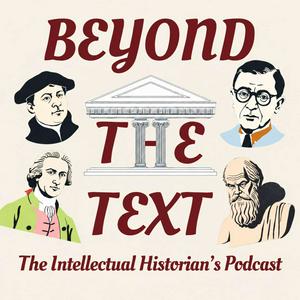
Welcome to Beyond the Text, a podcast series dedicated to delving into intellectual history with depth and context. In a world saturated with quick takes, Beyond the Text goes the extra mile. Paying homage to Skinner's insights on the importance of context, this podcast unveils overlooked aspects of historical and intellectual narratives.Co-hosted by Samuel Woodall and Jack Thomson, Beyond the Text explores the profound impact of thought and ideas throughout human history—forces that have driven change, shaped societies, and sparked revolutions. Beyond the mere words on the page, this podcast unravels the layers surrounding pivotal concepts and moments. Each episode meticulously examines the connections, influences, and societal currents that contribute to their evolution.Join us on this journey to grasp the true significance of intellectual history. Whether you're an enthusiast, a curious mind, or someone intrigued by the myriad forces shaping our world, Beyond the Text provides a space for nuanced exploration. Tune in and venture beyond the surface to understand the rich tapestry of our intellectual heritage.Samuel Woodall is a PhD candidate in Intellectual History at the University of Buckingham. He previously earned an MLitt in Intellectual History from the University of St. Andrews and a BA (Hons) in History and Politics from the University of Exeter.Jack Thomson holds an MA in Philosophy from the University of Buckingham and brings a philosophical lens to the exploration of ideas, ensuring each discussion is both rigorous and thought-provoking.
Site de podcastOuça Beyond the Text: The Intellectual Historian's Podcast, Wodcast e muitos outros podcasts de todo o mundo com o aplicativo o radio.net
Obtenha o aplicativo gratuito radio.net
- Guardar rádios e podcasts favoritos
- Transmissão via Wi-Fi ou Bluetooth
- Carplay & Android Audo compatìvel
- E ainda mais funções
Obtenha o aplicativo gratuito radio.net
- Guardar rádios e podcasts favoritos
- Transmissão via Wi-Fi ou Bluetooth
- Carplay & Android Audo compatìvel
- E ainda mais funções

Beyond the Text: The Intellectual Historian's Podcast
Leia o código,
baixe o aplicativo,
ouça.
baixe o aplicativo,
ouça.
 Brasil