PodcastsDocumentárioMid-life Men: the mental health podcast

Mid-life Men: the mental health podcast

Philip Briscoe
Mid-life Men: the mental health podcast
Último episódio

88 episódios

  • Mid-life Men: the mental health podcast

    When You Know Something Has to Change, with Dr James Rouse

    16/03/2026 | 41min
    In this episode I talk with Dr James Rouse, author of "No Days Off", about what that moment looked like for him. Growing up around alcohol, instability, and pressure to just get on with things, he followed a path a lot of men fall into: drinking too much, pushing himself hard physically, and trying to outrun how he felt rather than face it. 
    Some men don’t crash. They just reach a point where they quietly think: “I can’t keep living like this.” 
    What makes this conversation different is how honest he is about how change actually happened. Not a breakthrough. Not a rock-bottom moment. Just a slow realisation that if nothing changed, nothing was going to change. 
    We talk about things many men will recognise but rarely say out loud: 
    how easy it is to drift into habits you don’t feel proud of
    why many men try to "outwork" their problems instead of talking about them
    how small daily routines can start rebuilding self-respect
    why consistency matters more than motivation
    what to do when you don’t like yourself very much but still want things to improve
    James also brings something unusual to this discussion. He’s not just speaking from experience, he’s spent decades understanding what’s happening in the brain and body when men feel stuck, flat, or fed up with themselves.
     
    What comes through is simple but powerful: Change often starts before confidence does. Sometimes it just starts with doing one better thing today than you did yesterday.

    This isn’t an episode about dramatic transformation. It’s about something much more relatable: how ordinary men slowly get themselves back on track without making a big show of it.

    If you’ve ever looked at your life and thought “this isn’t where I wanted to end up”, this conversation will probably feel very familiar.
    To find out more about James, you can find him on Instragram: drjamesrouse, and his book "No Days Off" is available to buy online.
  • Mid-life Men: the mental health podcast

    How to Let Your Body Release Stress, with Richmond Heath

    10/03/2026 | 40min
    Most men deal with stress the same way: push through, stay in control, and keep going.
    But what if the body already has its own built-in way to release stress, and we’ve simply been taught to suppress it?
    In this episode I speak with Richmond Heath, a physiotherapist and one of the pioneers of Trauma Release Exercises (TRE) in Australia. Richmond’s interest in this work began with his own experience of chronic pain and high-functioning anxiety, which traditional treatments never fully resolved.
    His turning point came during a meditation retreat when his body began to move and release tension on its own, an experience that led him to explore how the nervous system stores stress and how the body can regulate itself.
    We discuss what TRE is and how it works: a simple method that activates the body’s natural tremor reflex to help release deep tension and calm the nervous system.
    In this conversation, you’ll learn:
    why stress and trauma are not just mental experiences but physical patterns held in the body.
    how chronic tension can quietly drive pain, anxiety, and exhaustion.
    why humans instinctively suppress shaking and trembling even though it’s a natural recovery response.
    how TRE helps the body down-regulate stress and restore balance.
    why learning to let go of control can sometimes be more powerful than trying to manage everything.
    This episode is not about quick fixes. It’s about understanding how the body and nervous system actually recover from stress and how reconnecting with that process can change the way we approach well-being, resilience, and midlife transitions.
    For anyone feeling worn down by constant pressure or curious about the deeper connection between stress and the body, this conversation offers a thoughtful introduction to an approach that many people have never encountered before.
    To find out more about TRE just search online. To find out more about Ricmond, visit the website treaustralia.com and search for Richmond Heath.
  • Mid-life Men: the mental health podcast

    The Price of Playing the Tough Guy, with Jacob Butchoff

    02/03/2026 | 1h 13min
    This is a difficult and honest conversation.
     For years, Jacob played the tough guy. 
    Violence, intimidation, and control became a shield against something he could not face in himself. The price was prison, addiction, fractured relationships and a life built on concealing his true identity. 
    Adopted as a baby and raised in a loving, privileged home in North London, Jacob grew up with a persistent sense of not belonging. Alongside that was the realisation, from a young age, that he was gay. Instead of acknowledging it, he suppressed it.
    What followed was not confusion, it was deliberate rejection of himself.
    He constructed a persona built on aggression and intimidation. Violence became a way to avoid scrutiny. Crime became a way to reinforce the mask. That path led to prison, addiction, secrecy, and years of internal conflict.
    This episode does not romanticise any of it.
    Jacob speaks plainly about:
    Growing up adopted and carrying an unspoken sense of difference
    The exhaustion of maintaining two identities
    Using violence as protection
    The psychological reality of prison
    Addiction and isolation after release
    Searching for identity in the wrong places
    Caring for his father with dementia and confronting what truly matters
    Coming to terms with his sexuality later in life
    There are no easy lessons in this story. It is uncomfortable at times. But it is real.
    Why listen?
    Because while few men will follow Jacob’s exact path, many will recognise parts of it, the mask, the suppression, the anger, the attempt to prove strength instead of admitting fear.
    This episode is about the cost of self-rejection. It is about responsibility. It is about identity. And it is about the slow work of rebuilding a life once you decide to stop running.
    Jacob does not present himself as a victim. He accepts the consequences of his actions. What he offers instead is perspective: strength is willingness to live honestly, even after years of doing the opposite.
    This conversation will not be for everyone. But for those who are carrying something unspoken, it may resonate more than they expect.
  • Mid-life Men: the mental health podcast

    Feeling Like I’m From Mars: Late Autism Diagnosis, with Gary Hawkins

    02/03/2026 | 42min
    What happens when you grow up feeling like you don’t quite fit, and you spend decades assuming the problem is you?
    In this episode, I speak with Gary Hawkins, a long-serving NHS clinician who was diagnosed as autistic later in life. Gary’s story is not neat or linear. It includes childhood chaos, being labelled “unteachable,” boarding school, the traumatic loss of his father in the Falklands, years of masking in professional environments, severe burnout, misdiagnosis, medication that didn’t help, and eventually, a diagnosis that brought clarity rather than cure.
    This is not a conversation about labels for the sake of labels. It’s about identity, shame, exhaustion, and the quiet cost of trying to pass as “normal” for decades.
    Gary speaks candidly about:
    Growing up feeling like he was “from Mars”
    The impact of trauma layered on top of neurodiversity
    Being misdiagnosed and treated for the wrong things
    The experience of masking in professional life, and the exhaustion that follows
    Why autism is not a mental illness, but a different operating system
    The increased risk of depression and suicide in autistic men
    Why diagnosis doesn’t change your life, but can change how you see yourself
    And why men are particularly poor at talking about how they really feel
    We also explore the overlap between mental health and neurodiversity, and why many men may have spent years thinking they are lazy, difficult, arrogant, or broken, when in reality they may simply process the world differently.
    This episode is relevant not only for those considering whether autism or neurodiversity might apply to them, but for anyone who has:
    Felt chronically out of place
    Struggled with social situations but excelled professionally
    Experienced burnout that didn’t make sense
    Been told they’re “too much” or “not enough”
    Spent years masking to survive
    Gary doesn’t present autism as a superpower. Nor does he present it as tragedy. He presents it as reality — complex, nuanced, sometimes painful, and deeply human.
    Perhaps most importantly, this conversation is about self-acceptance. Not as a slogan, but as hard-won ground.
  • Mid-life Men: the mental health podcast

    Hard Choices, Easy Life, with Jerzy Gregorek

    02/02/2026 | 53min
    You won’t hear many life stories like this.
    Jerzy Gregorek’s life spans teenage alcoholism and suicidal thoughts, elite Olympic-level weightlifting, political exile from communist Poland, serious injury and paralysis, underground resistance work, and the long, unglamorous process of starting again in a new country. More than once.
    What makes this episode different is that Jerzy doesn’t romanticise any of it. He speaks plainly about the cost of bad choices, the patience required to rebuild, and the quiet discipline that slowly turns chaos into stability.
    Out of that lived experience comes a principle Jerzy is known for, and one that keeps resurfacing throughout this conversation:
    Hard choices, easy life.
    Easy choices, hard life.
    We talk about what that really looks like over decades, not weeks:
    how small, daily decisions quietly compound over time, for better or worse
    why discipline isn’t punishment, but a way out
    how men lose themselves when they chase comfort instead of progress
    why strength, learning, and mentors matter more than motivation
    and why it’s never too late to choose a harder path that leads somewhere better.
    Alongside his own journey, Jerzy has spent decades working with others in the US through writing, poetry, and physical training. Through his gym and his book The Happy Body, he brings together strength, philosophy, and lived experience, helping people understand how the body, mind, and daily discipline shape each other over time. This work isn’t theoretical; it’s an extension of the life he’s lived and the principles he’s tested on himself first.
    This isn’t a story about quick fixes or overnight transformations. It’s about playing the long game, physically, mentally, and morally, and accepting that meaningful change usually comes from doing difficult things consistently, when no one is watching.
    If you want to learn more about Jerzy and his work, visit thehappybody.com.
Mais podcasts de Documentário

Sobre Mid-life Men: the mental health podcast

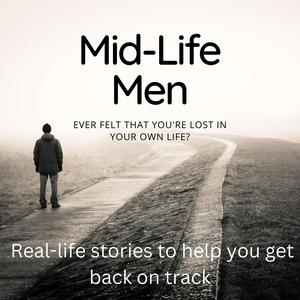
Have you ever felt like you’ve become lost in your own life? Many men struggle to talk about their problems and mental health and grew up believing that to do can be perceived as a sign of weakness or failure. There is also a lack of open discussion in society around men’s mental health, especially aimed at mid-life men. As a result, at times many men can feel alone and lost in their own lives. In this podcast series, I talk to mid-life men about their stories; the challenges, the turning points, and the support received to help them find their way so that others who may be suffering in silence or don’t know what to do next, realise that they are not alone and there is help available. Stories will cover a whole range of challenges faced by mid-life men mainly relating to the causes of mental health issues including feelings of isolation, depression, job dissatisfaction, addiction, PTSD, and long-term illness.The podcast is NOT a replacement for professional support and we signpost to organisations and their contact details by episode. If you have a story you would like to share or any feedback on the podcasts, please email me: [email protected].
Site de podcast

Ouça Mid-life Men: the mental health podcast, Escafandro e muitos outros podcasts de todo o mundo com o aplicativo o radio.net

Obtenha o aplicativo gratuito radio.net

  • Guardar rádios e podcasts favoritos
  • Transmissão via Wi-Fi ou Bluetooth
  • Carplay & Android Audo compatìvel
  • E ainda mais funções

Mid-life Men: the mental health podcast: Podcast do grupo

Informação legal
Aplicações
Social
v8.8.2 | © 2007-2026 radio.de GmbH
Generated: 3/19/2026 - 6:31:13 PM