

Ouça este podcast gratuitamente no aplicativo: Baixe gratuitamente na App Store
radio.net
Sleeptimer
Guardar rádio
127 episódios
What Nutrition Scientists Actually Agree On with Christopher Gardner, PhD | MGC Ep. 127
12/10/2026 | 57minNutrition advice seems to change every week, but Dr. Christopher Gardner says the core of what we know has barely moved in fifty years.
In this episode of The Mind-Gut Conversation, Dr. Mayer talks with Gardner, a professor of medicine at Stanford University, about his new book, Food Sense. Gardner has studied nutrition for more than three decades, served on the Dietary Guidelines Advisory Committee, and sits on the scientific advisory board of the Culinary Institute of America. He is not selling a product, and he makes the case that there is much more consensus in nutrition than social media suggests.
They discuss what GLP-1 weight loss drugs may and may not change about our relationship with food, whether you need animal protein to stay strong and active, and where protein anxiety comes from. They also look at the research on dairy and fermented foods, why the word inflammation is thrown around so freely, and how politics shapes the dietary guidelines.
Topics discussed include:
• Why Gardner says there is more agreement in nutrition than the headlines show
• What we know and don’t know about GLP-1 drugs
• Plant protein, animal protein, and the fiber gap
• Dairy, lactose intolerance, and fermented foods
• Inflammation, seed oils, and what the evidence supports
• How industry and politics influence what we are told to eat
If you have ever felt anxious in a grocery aisle or at a restaurant table, this conversation offers a calmer way to think about food.
His new book, Food Sense, is available on Amazon October 13th, 2026!
-----------------------------------------
Connect with Dr. Mayer:
Website: https://www.emeranmayer.com
Instagram: https://www.instagram.com/emeranmayer/
X: https://x.com/emeranmayermd
Facebook: https://www.facebook.com/EmeranMayerMD/
LinkedIn: https://www.linkedin.com/in/emeranmayer/
-----------------------------------------
Chapters:
0:00 - Introduction
4:00 - The Main Message of Food Sense
9:42 - GLP-1 Drugs and the Food Environment
21:13 - Plant Protein vs. Animal Protein
35:12 - Food Politics, Dietary Guidelines, and Dairy
44:37 - Fermented Foods, Inflammation, and Seed Oils
54:27 - Closing: What Gardner EatsHealthspan vs. Lifespan: What It Takes to Stay Healthy Longer with Dr. Jamie Justice | MGC Ep. 126
19/09/2026 | 59minOver the past century, average lifespan in Western countries has grown by about 30 years. The years we spend in good health have not kept pace.
In this episode of The Mind–Gut Conversation, Dr. Mayer is joined by Dr. Jamie Justice, Executive Vice President of the Health Domain at the XPRIZE Foundation and Executive Director of XPRIZE Healthspan, a $101 million, seven-year global competition to find therapies that restore muscle, cognitive, and immune function in older adults.
They discuss the roughly 12-year gap between lifespan and healthspan, why research in worms, flies, mice, and non-human primates suggests aging may be modifiable, and how the XPRIZE competition model rewards teams for demonstrated results rather than proposals. Dr. Justice explains why she does not consider aging a disease, why lifestyle interventions and new therapies should be tested side by side, and what it would take to separate evidence from hype in the consumer longevity market.
The conversation closes with the bigger questions: how long humans could realistically live, and how society needs to rethink purpose, work, and technology as more people live into their 80s, 90s, and beyond.
Topics discussed include:
• Why healthspan has not kept up with lifespan
• How the XPRIZE Healthspan competition works
• Why aging is a risk factor, not a disease
• Lifestyle interventions vs. new longevity therapies
• Evidence standards in the consumer longevity market
• The limits of lifespan extension and what it means for society
This is a practical, science-driven discussion for anyone interested in longevity, healthy aging, and the future of aging research.
------------------------------
This episode is sponsored by Mayer Nutrition, co-founded by Dr. Emeran Mayer. Polyphenols are the plant compounds found in berries, cocoa, green tea and olive oil, and most of their value comes from what happens in your gut: your microbes convert them into compounds your body can absorb and use.
Mayer Nutrition makes food and nutrition products built on Dr. Mayer's research into the brain-gut-microbiome system.
Save 10% with code MINDGUT. Learn more at mayernutrition.com.
------------------------------
Chapters:
0:00 - Introduction
3:37 - Why Has Interest in Longevity Surged?
7:02 - Healthspan vs. Lifespan
14:35 - Inside the XPRIZE Healthspan Competition
24:26 - Lifestyle Interventions vs. New Therapies
37:49 - Is Aging a Disease?
48:30 - How Long Could Humans Live?
56:01 - Closing RemarksWhat Is The Mayer Model? with Emeran Mayer, MD | MGC Ep. 125
01/09/2026 | 7minAfter 45 years of research on how the brain and the gut communicate, the question Dr. Emeran Mayer hears most often is not about mechanisms or studies. It is much simpler than that. People tell him they understand the science, they just do not know how to live it.
In this episode of The Mind-Gut Conversation, Dr. Mayer introduces The Mayer Model, the book he has been working toward for his entire career. He explains why his earlier books, The Mind-Gut Connection and The Gut-Immune Connection, focused on explaining the biology, and why this one is built to close the gap between the evidence and the ordinary decisions people make every day about food, stress, sleep, movement, and recovery.
He traces the long view of how the idea of a bidirectional brain-gut conversation went from a fringe interest to one of the most active areas in biomedical research, and how the discovery of the gut microbiome as a third participant reorganized the entire model. Food is not simply fuel. It is information that trillions of microbes transform into signals that reach every organ, including the brain.
The Mayer Model is not a diet and not a protocol. It is a systems-based way of understanding your own biology clearly enough to make better decisions inside it. Across seven chapters, the book covers the role of diet in shaping the brain-gut-microbiome system, gut-healthy recipes, and detailed guidance on building a gut-healthy lifestyle through movement, sleep, contemplative practices, and vagal stimulation.
Dr. Mayer also shares who he wrote the book for, and how listeners can access a set of launch-window bonuses, including a live Q&A over Zoom, a guided meditation, a recipe guide, and a Mayer Nutrition coupon.
The Mayer Model is available now on Amazon: https://a.co/d/0bkjOcxP
Launch bonuses: https://themayermodel.com/
Topics discussed include:
• Why understanding gut science is not the same as applying it
• How brain-gut research moved from the fringe to the mainstream
• The gut microbiome as the third participant in the brain-gut conversation
• What The Mayer Model is, and what it is not
• What is inside the seven chapters of the book
• Who the book is for, and how to claim the launch bonuses
This episode is brought to you by Mayer Nutrition. We believe real food comes first. A diverse, plant-forward diet is the foundation of a healthy brain-gut-microbiome system, and everything we make is designed to support that foundation rather than replace it. When you want extra support, Mayer Nutrition offers science-informed products like Synaptic Bloom and our proprietary extra virgin olive oil.
Use code MINDGUT for 10% off your first order at www.mayernutrition.com
Connect with Dr. Mayer:
Website: https://www.emeranmayer.com
Instagram: https://www.instagram.com/emeranmayer/
X (Twitter): https://www.x.com/emeranmayermd
Facebook: https://www.facebook.com/EmeranMayerMD/
LinkedIn: https://www.linkedin.com/in/emeranmayer/
Chapters:
0:00 - Introduction
1:04 - The Long View: 45 Years of Brain-Gut Research
2:12 - The Third Participant: The Gut Microbiome
3:15 - From Explanation to Application
4:03 - What Is The Mayer Model?
5:25 - Who This Book Is For
6:12 - How to Get the Book and Launch BonusesWhy Are We Living Longer But Not Healthier? with Emeran Mayer, MD | MGC Ep. 124
18/08/2026 | 12minModern medicine has never been better at keeping people alive. So why are we spending more of our lives unwell?
In this episode of The Mind-Gut Conversation, Dr. Emeran Mayer examines a new analysis from the Global Burden of Disease project, published in Lancet Public Health, comparing how long people live with how many of those years are lived in good health across 204 countries and territories.
The difference between those two numbers is called the morbidity gap. In 1990 the average person could expect to spend 8.8 years of life in poor health. By 2023 that had risen to 10.7 years, and the gap widened in 203 of the 204 places studied. The wealthiest countries fare worst of all, with the United States leading globally at 14 years.
Dr. Mayer explains what is actually driving those unhealthy years, why the trend now extends across the entire adult lifespan rather than clustering in old age, and why two of the largest contributors sit squarely within the brain-gut-microbiome system.
Topics discussed include:
• What the morbidity gap is and how it is measured
• Why the 45-year-old compression of morbidity hypothesis is being challenged
• Why high-income countries carry the largest health gaps
• The five conditions responsible for most unhealthy years worldwide
• Why health decline is starting in middle age
• The gender health paradox
• Why years lived may be the wrong scoreboard
This is a science-driven discussion for anyone interested in healthspan, healthy aging, and chronic disease prevention.
---------------------------
This episode is sponsored by Mayer Nutrition. Food comes first, always. For the places where diet leaves a gap, use code MINDGUT for 10% off your first order.
---------------------------
Chapters:
0:00 - Introduction
1:00 - What This Study Set Out to Test
2:23 - The Morbidity Gap Explained
3:35 - Why Wealthy Countries Rank Worst
5:05 - Health Decline in Middle Age
6:10 - What Fills the Unhealthy Years
7:28 - Men, Women, and the Health Gap
8:31 - Rethinking How We Measure Success
9:39 - Closing Thoughts
11:25 - A Word From Our SponsorPsychedelics for IBS: Inside the First Clinical Trial with Erin Mauney, MD
04/08/2026 | 56minFor most of the last forty years, irritable bowel syndrome was treated as a problem of the gut alone. The idea that the brain plays a central role took decades to gain acceptance, and it remains contested today.
In this episode of The Mind-Gut Conversation, Dr. Mayer is joined by Dr. Erin Mauney, a pediatric gastroenterologist and researcher at Harvard and Massachusetts General Hospital, who has completed one of the first clinical trials of psilocybin-assisted therapy for patients with treatment-resistant IBS.
They discuss why a compound acting primarily on the brain might change how the gut is experienced, what happens when the brain’s prediction machinery becomes locked into a cycle of pain and anticipation, and why the therapy surrounding the dosing sessions may matter as much as the molecule itself.
The conversation also takes on the harder questions. How do you run a placebo-controlled trial when every participant knows they received the drug? Can the psychedelic experience be engineered out of psychedelic medicine, and what is lost if it is? And what can practices used ritually for millennia still teach a reductionist Western model of care?
This is early-stage science, and Dr. Mauney is refreshingly clear about the limits of what is currently known. It is also a glimpse at what the next chapter of brain-gut medicine might look like.
Topics discussed include:
• Why IBS is best understood as a disorder of gut-brain interaction
• How the brain’s predictive coding can become locked into chronic pain
• What psilocybin-assisted therapy actually involves, session by session
• Whether the psychedelic experience itself is essential to the benefit
• The placebo problem in psychedelic trials, and why it may be unsolvable
• How long the benefits appear to last after treatment ends
• Where psychedelic research in gastroenterology may be headed
This is a careful, evidence-based conversation for anyone interested in IBS, chronic pain, and the future of brain-gut medicine.
Chapters:
0:00 - Introduction
3:23 - IBS as a Brain-Gut Disorder
7:40 - Entering Psychedelic Research
13:22 - How Psilocybin Could Affect the Gut
15:43 - Inside the Trial
17:50 - The Brain and Pain Prediction
21:18 - Side Effects and Patient Experience
25:40 - Does the Psychedelic Experience Matter?
29:57 - Ritual and Western Medicine
32:15 - The Placebo Question
36:33 - Combining Therapies
39:10 - Brain Imaging
40:56 - Practical Challenges
44:07 - Durability of Benefits
47:23 - Overlap With Other Conditions
49:28 - Where the Research Goes Next
54:11 - Looking Ahead
Mais podcasts de Saúde e fitness









Podcasts em tendência em Saúde e fitness












Sobre The Mind-Gut Conversation Podcast
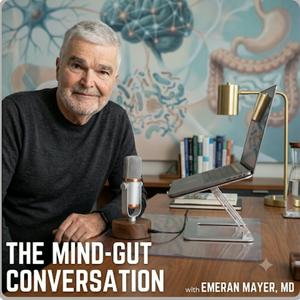
The Mind-Gut Conversation brings in experts within various fields of health & science to have a discussion with world-renowned gastroenterologist, neuroscientist and bestselling author of The Mind Gut Connection, Emeran Mayer, MD.
Site de podcastOuça The Mind-Gut Conversation Podcast, Autoconsciente Podcast | Vida interior e muitos outros podcasts de todo o mundo com o aplicativo o radio.net
Obtenha o aplicativo gratuito radio.net
- Guardar rádios e podcasts favoritos
- Transmissão via Wi-Fi ou Bluetooth
- Carplay & Android Audo compatìvel
- E ainda mais funções
Obtenha o aplicativo gratuito radio.net
- Guardar rádios e podcasts favoritos
- Transmissão via Wi-Fi ou Bluetooth
- Carplay & Android Audo compatìvel
- E ainda mais funções

The Mind-Gut Conversation Podcast
Leia o código,
baixe o aplicativo,
ouça.
baixe o aplicativo,
ouça.
The Mind-Gut Conversation Podcast: Podcast do grupo
 Brasil