

Ouça este podcast gratuitamente no aplicativo: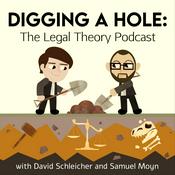 Baixe gratuitamente na App Store
radio.net
Sleeptimer
Guardar rádio
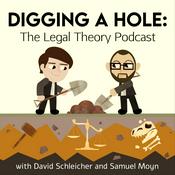
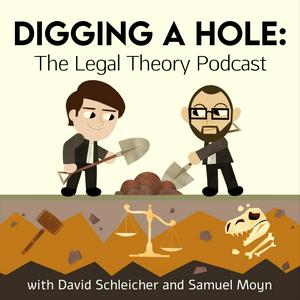
Digging a Hole: The Legal Theory Podcast
Digging a Hole Podcast
Último episódio
81 episódios
Joshua Specht
23/09/2026 | 56minSummer is over, dear listeners. Sam spent his time reading hate mail from older Americans, while David has just moved around the corner from a senior assisted living facility. But more importantly, Digging a Hole is back for another season.
In this week’s episode, we turn to the history of America’s obsession with land ownership. Here to take us from the rent wars of the 1840s up to the Great Financial Crisis, we have Joshua Specht, associate professor of history at the University of Notre Dame. He joins us to discuss his new book, Property Values: The Rise and Fall of the American Homeowner, which traces the history of American property ownership from the homestead to the modern suburb.
Specht lays out his argument that American history can be understood through two linked ideals: nineteenth-century “landed democracy,” in which widespread land ownership underwrote visions of independence and citizenship, and the twentieth-century “ownership society,” which moved those aspirations to suburban homes. Sam questions whether land ownership and homeownership really belong in a single story and whether Americans might someday manage to untether democracy from owning a piece of land altogether. David, meanwhile, asks whether Specht’s narrative gives too much explanatory power to property ownership and not enough to economic growth and dynamism. He also wonders whether the decisive break in American housing really came with the mortgage revolution of the 1930s or with the rise of anti-growth politics in the 1970s.
Referenced Readings
Property Values: The Rise and Fall of the American Homeowner, by Joshua Specht
Red Meat Republic: A Hoof-to-Table History of How Beef Changed America, by Joshua Specht
“The Price of Meat,” by Samuel Moyn
“How the Gentry Won: Property Law’s Embrace of Stasis,” by Roderick M. Hills Jr. and David Schleicher
“The Significance of the Frontier in American History,” by Frederick Jackson Turner
Crabgrass Frontier: The Suburbanization of the United States, by Kenneth T. Jackson
Americans Against the City: Anti-Urbanism in the Twentieth Century, by Steven ConnSarath Sanga
08/06/2026 | 1h 9minThings are looking up, dear listeners. The semester is over, summer is nearly here, and David’s beloved Knicks are up 2-0 in the NBA Finals.
In this week’s episode, we take a step back and do some introspection. Here to discuss whether you should trust Yale, and other elite universities, more than Jalen Brunson in the fourth quarter is friend and colleague Sarath Sanga, Professor of Law at Yale Law School and Co-Director of the Yale Law School Center for the Study of Corporate Law. Sanga joins us to discuss both his new article, A Theory of Trust in Institutions, co-authored by Yehonatan Givati, and the recent Report by the Yale Committee on Trust in Higher Education, of which Sanga was a member.
Sanga kicks off the episode by explaining his view of why higher education is hemorrhaging public trust. Sanga argues that universities, and other institutions, pre-commit to doing specific things, and they lose trust whenever they stray from this initial commitment. Sam questions whether universities are now, and always have been, finishing schools for elites and, if so, whether it makes sense to talk about institutions like Yale having a mandate. And David brings up a variety of counterexamples that call into question whether an institution going against its mandate, such as when a university fields varsity sports teams, actually decreases trust in the real world. We hope you enjoy!
Referenced Readings
A Theory of Trust in Institutions, by Sarath Sanga and Yehonatan Givati
Report of the Yale Committee on Trust in Higher Education, by Yale University
"Shut Up and Dribble", by Ian Ayres
A Running List of Nominations for the Canon of American Legal Thought (1975-2025)
A Matter of Interpretation, by Antonin Scalia [Grove]
“A Neo-Federalist View of Article III”, by Akhil Reed Amar [Grove]
“The Anticanon”, by Jamal Greene [Grove]
The Economic Structure of Corporate Law, by Frank Easterbrook and Daniel Fischel [Macey]
“The Costs of Employment Segregation: Evidence from the Federal Government Under Woodrow Wilson”, by Abhay Aneja and Guo Xu [Sanga]
This episode is all about how Yale, and other elite institutions, are losing public trust. As Yale Law School insiders, what’s your best solution for making YLS more trustworthy?
Sam: I’m very suspicious of law schools, especially ours-why shouldn’t everyone else be?
David: I’m not sure that there is one quick trick in a polarized country, unless we can ensure that none of our graduates ever have an opinion that anyone of any political party ever disagrees with. That said, the best plan is to focus on what we’re good at, teaching brilliant students (like Daniel Browning, our out-going EP and all-around superstar!) and producing a broad range of excellent and rigorous scholarship.Lawrence Douglas
05/06/2026 | 48minAs gas reaches stratospheric prices and the cost of living continues to climb, war seems to be on everyone’s mind these days. What better time, then, to be joined by Lawrence Douglas, the James J. Grosfeld Professor of Law, Jurisprudence and Social Thought at Amherst College, to discuss his brand new book, The Criminal State: War, Atrocity, and the Dream of International Justice?
The episode begins with an overview of two paradigms in international criminal law. Douglas argues that international law has replaced the “aggression paradigm,” which emerged out of the Nuremberg trials, in favor of an “atrocity paradigm,” which focuses on sanctioning grievous acts of violence, especially towards civilians. However, Douglas suggests that both the atrocity paradigm and the now-defunct aggression paradigm suffer from serious deficiencies. Sam asks whether there really has been an aggression-atrocity shift or, instead, whether the aggression paradigm utterly failed, with a long delay before the separate construction of an atrocity paradigm — which itself proved short-lived. David queries whether Douglas’s story is too formalistic and already out of date. And, fortunately for everyone, we resist the urge to do the entire episode in Seinfeld voices.
Referenced Readings
Humane, by Samuel Moyn
From Aggression to Atrocity: Rethinking the History of International Criminal Law,” by Samuel Moyn
The Internationalists, by Oona Hathaway and Scott Shapiro
A Running List of Nominations for the Canon of American Legal Thought (1975-2025)
A Matter of Interpretation, by Antonin Scalia [Grove]
“A Neo-Federalist View of Article III”, by Akhil Reed Amar [Grove]
“The Anticanon”, by Jamal Greene [Grove]
The Economic Structure of Corporate Law, by Frank Easterbrook and Daniel Fischel [Macey]
In this episode, Douglas proposed co-teaching an international law seminar with Sam. If you could teach a seminar on anything, unencumbered by ABA requirements or Yale Law School bureaucracy, what would you teach?
David: Hmmm… Stoicism: From Marcus Aurelius to O.G. Anunoby. Or perhaps Art History 601: The Art of Walt “Clyde” Frazier’s suits. Or maybe Negotiation 401: How Jalen Brunson Won By Taking Less
Sam: “French Pastry”? I would have listed “Why I Dropped Out of Law School and You Should Too” but then I realized I manage to include the material in most of my classes…Anton Jäger
12/05/2026 | 55minNow that classes are over and the end of the semester is near, we’re back for several weeks of podcastmaxxing. So stay tuned for some great episodes in the coming weeks, dear listeners!
Here to help us understand our current political moment and to diversify David’s reading list is Anton Jäger, a Departmental Lecturer in the History of Political Thought and Political Theory at University College, Oxford. Jäger joins the pod this week to discuss his new book, Hyperpolitics: Extreme Politicization without Political Consequences, where he offers a European’s perspective on the American political moment.
This episode begins with an explanation of what, exactly, hyperpolitics is and how it differs from other, older forms of politics. Jäger suggests that hyperpolitics is characterized by a high degree of political involvement but a corresponding deinstitutionalization of politics. Sam queries whether our current moment might be more continuous with the past, with both characterized by a quiescent politics. And David asks about the degree to which our politics has been causally determined by economic forces. Along the way, we also discuss whether it’s helpful to label the Trump movement as fascist, whether hyperpolitics is the product of liberalism’s failure, and whether the smartphones are really to blame for everything. We hope you enjoy!
Referenced Readings
The Hollow Parties, by Daniel Schlozman and Sam Rosenfeld
Bowling Alone, by Robert Putnam
The Dark Side of Democracy, by Michael Mann
The Project-State and its Rivals, by Charles Maier
A Running List of Nominations for the Canon of American Legal Thought (1975-2025)
A Matter of Interpretation, by Antonin Scalia [Grove]
“A Neo-Federalist View of Article III”, by Akhil Reed Amar [Grove]
“The Anticanon”, by Jamal Greene [Grove]
The Economic Structure of Corporate Law, by Frank Easterbrook and Daniel Fischel [Macey]
On this week’s episode, Jäger offered a European outsider’s take on American politics. Flipping the script, what’s your best outsider’s take on European politics?
Sam: The first wave of right-wing victory is over, and now it is coming for France and Germany. Get ready.
David: I can’t believe that British politics is not full of people with their hair on fire about why the country’s economic growth has been so slow – Poland is likely to catch up in per capita GDP in a few years! And, if anything, de-growther forces, on both the right and left, are rising. It’s like the frogs in slowly boiling water croaking requests to turn up the temperature.Joshua Macey
26/03/2026 | 55minSpring has sprung, dear listeners. Now that this dreadfully cold winter seems to be behind us, our power bills might finally come back down to Earth. Here to explain why your electricity bill is so expensive – and what to do about it – is Joshua Macey, a Professor of Law at Yale Law School. Macey’s research and teaching interests are wide-ranging, from energy and environmental law to bankruptcy and legal theory.
In this episode of the pod, we get into the nitty gritty on energy, utilities, and governance strategies. The episode begins with a discussion of whether, and under what circumstances, centralized government regulation is (and is not) better than competition among private energy providers. We then tackle several big theoretical questions, such as the best methodology for analyzing regulatory policy, whether a carbon tax could be effective, and whether there should be an Abundance agenda for energy. And we also talk practical solutions: Why don’t we create a vast inter-state energy network? Should every state adopt the Texas approach of “surge pricing” during times of increased electricity demand? And more.
The episode concludes with another excellent nomination for the Canon of American Legal Thought (1975-2025).
Referenced Readings
“Behavior of the Firm under Regulatory Constraint”, by Harvey Averch and Leland Johnson
The Economic Structure of Corporate Law, by Frank Easterbrook and Daniel Fischel
“The Corporate Governance of Public Utilities”, by Aneil Kovvali and Joshua Macey
“In Defense of Chapter 11 for Mass Torts”, by Anthony Casey and Joshua Macey
“Inside or Outside the System?”, by Eric Posner and Adrian Vermeule
A Running List of Nominations for the Canon of American Legal Thought (1975-2025)
A Matter of Interpretation, by Antonin Scalia [Grove]
“A Neo-Federalist View of Article III”, by Akhil Reed Amar [Grove]
“The Anticanon”, by Jamal Greene [Grove]
The Economic Structure of Corporate Law, by Frank Easterbrook and Daniel Fischel [Macey]
This episode features a discussion of whether a carbon tax could effectively curb climate change. And David has recently called attention to the new property tax revolt. In this spirit, what’s something you think should be taxed, but currently is not?
Sam: In my new book, I argue for a new suite of tax laws that attack the nexus of age and wealth - for example, by incentivizing departure from homes for those who have means to leave and, because they are older, often occupy more square footage than they need.
David: Lots of possibilities – low taxes on different tax bases can be very attractive, as the deadweight loss of taxation gets increasingly worse as a single tax gets higher. A serious answer is congestion. Driving downtown during busy periods creates huge externalities, and once passed, as NYC’s experience shows, congestion charges become popular because they reduce traffic.
A less serious but equally strongly-felt answer: a progressive tax on the length of meetings, particularly Zooms. How happy would the world be if the person who said “one more thing” at the end of meeting faced a stiff penalty! Also, of course, seconds of speeches during faculty meetings!!!
Finally, my wife would also say there should be a tax on exclamation points in emails, as it would encourage people to sound less deranged!!! And by people, she definitely means me :)
Mais podcasts de Ciência









Podcasts em tendência em Ciência













Sobre Digging a Hole: The Legal Theory Podcast
Yale Law School professors Samuel Moyn and David Schleicher interview legal scholars and dig into the debates heard inside law school halls.
Site de podcastOuça Digging a Hole: The Legal Theory Podcast, Geografia em Meia Hora e muitos outros podcasts de todo o mundo com o aplicativo o radio.net
Obtenha o aplicativo gratuito radio.net
- Guardar rádios e podcasts favoritos
- Transmissão via Wi-Fi ou Bluetooth
- Carplay & Android Audo compatìvel
- E ainda mais funções
Obtenha o aplicativo gratuito radio.net
- Guardar rádios e podcasts favoritos
- Transmissão via Wi-Fi ou Bluetooth
- Carplay & Android Audo compatìvel
- E ainda mais funções

Digging a Hole: The Legal Theory Podcast
Leia o código,
baixe o aplicativo,
ouça.
baixe o aplicativo,
ouça.
 Brasil