
Ouça este podcast gratuitamente no aplicativo: Baixe gratuitamente na App Store
radio.net
Sleeptimer
Guardar rádio
645 episódios
Why Consciousness Needs a Body
17/10/2026 | 1h 19minWhy does being alive feel like something? Neuroscientist Antonio Damasio argues that the answer begins with the body's need to stay alive. Hunger, thirst, pain, and pleasure tell us how we're doing and push us to act. These basic feelings, he says, are the foundation of consciousness.
Damasio returns to the show to discuss his new book, Natural Intelligence and the Logic of Consciousness, why feelings and emotions are different, what your dog knows about you, and why he thinks Francis Crick looked in the wrong place for the origins of conscious experience.
If consciousness depends on a living body, could a computer ever have it? And would uploading your brain actually preserve you? Damasio leaves room for a form of machine consciousness, though he argues it would be fundamentally different from ours. He also talks about what brain injuries reveal about the mind, how psychedelics change our perception, where human choice comes from, and why religion offers such powerful comfort.
Antonio Damasio is David Dornsife Professor of Neuroscience, Psychology and Philosophy, and director of the Brain and Creativity Institute at the University of Southern California, Los Angeles. Considered one of the most eminent scientists of our time, he has made fundamental contributions to the understanding of brain processes and their relationship to emotions and consciousness. He has discussed his research in books such as Descartes' Error, The Sensation of What Happens, Looking for Spinoza, and The Strange Order of Things.Racism and White Guilt: Has America Changed More Than We Admit? | Shelby Steele & Eli Steele
10/10/2026 | 41minCan fighting racism end up reinforcing it? Shelby Steele grew up under segregation and became a Black militant in the 1960s.
Today, he argues that White guilt has created a different racial problem: treating Black Americans as permanent victims who cannot succeed without White help. Shelby and his son, filmmaker Eli Steele, join Michael Shermer to discuss White Guilt, their new documentary about Shelby's life and America's changing racial politics.
Shelby recalls a university colleague who assumed she could count on his vote simply because he was Black. He explains why he sees the same thinking in affirmative action and the expectation that Black Americans should share the same beliefs. Michael asks whether affirmative action was ever justified and how much America has changed since the Civil Rights Movement.
For Shelby and Eli, what's at stake is the individual, the radical idea that every human being stands equal under the law, fully accountable for his own life, free to rise or fall on his own terms. White guilt doesn't just undermine the individual. It replaces the individual with the tribe, and freedom with the scramble for victim status.
The documentary White Guilt is available for purchase at https://www.whiteguiltfilm.com and streaming on Amazon Prime, Apple TV, and Google Play.
Eli Steele is a filmmaker and writer. He has made over 20 documentaries. He has written for the Wall Street Journal, City Journal, Quillette, and other publications. He is the son of Shelby Steele.
Shelby Steele is a senior fellow at the Hoover Institution at Stanford University. His work spans several books, documentary films, essays, and scholarly articles. His honors include the National Book Critics Circle Award for "The Content of Our Character," an Emmy Award, a National Humanities Medal, and a Bradley Prize.Would You Want to Know If You Were Wrong?
28/09/2026 | 1h 38minWhat do you make of an experience you can't explain? A strange light in the sky, a book flying off a desk, a coincidence that feels too improbable to be chance? Social psychologist Barry Markovsky joins Michael Shermer to discuss his new book Everyday Extraordinary and the experiences that have kept him studying paranormal beliefs for decades—including his own childhood UFO sighting and a supposedly haunted vape shop.
Markovsky explains how friends, communities, and our sense of who we are shape what we believe—and why changing someone's mind can take more than better evidence.
Barry Markovsky is Distinguished Professor Emeritus of Sociology at University of South Carolina. His articles on ghosts, UFOs, and coincidences appear at TheConversation.com, which disseminates them to major news outlets worldwide. To date, more than a million readers have downloaded them. His new book is Everyday Extraordinary.Does Consciousness Break the Laws of Physics?
22/09/2026 | 46minIf we could explain everything happening in your brain, would there still be something left to explain about you? Physicist Avshalom Elitzur thinks so—and argues that accounting for consciousness may require changing the laws of physics. In this lively conversation, Michael Shermer challenges Elitzur on why subjective experience should be anything more than a product of the brain, whether an AI could be conscious, and what a hypothetical human without consciousness would have to say about any of this.
Avshalom Elitzur is an Affiliate Professor at the Institute for Quantum Studies, Chapman University, and a senior researcher at Iyar, the Israel Institute for Advanced Research. He works in the foundations of quantum mechanics and is best known for the Elitzur–Vaidman bomb-testing problem.Jared Diamond: How Much Can One Person Change History?
15/09/2026 | 1h 29minWould World War II have happened without Hitler? Would someone else have built Apple without Steve Jobs? Jared Diamond joins Michael Shermer to ask how much history depends on particular people.
From Darwin's discoveries to the rise of Christianity, Diamond considers when someone is truly irreplaceable, when someone else would have done much the same thing, and how we can tell the difference.
Jared Diamond is the Pulitzer Prize-winning author of the seminal million-copy-bestseller Guns, Germs, and Steel, which was named one of Time magazine's best non-fiction books of all time, Collapse, a No. 1 international bestseller, and The World Until Yesterday, among other books. A professor of geography at UCLA and noted polymath, Diamond's work has been influential in the fields of anthropology, biology, ornithology, ecology and history, among others. His new book is Profits, Prophets, Coaches, and Kings: (When) Do Leaders Matter?
Mais podcasts de Ciência




Podcasts em tendência em Ciência











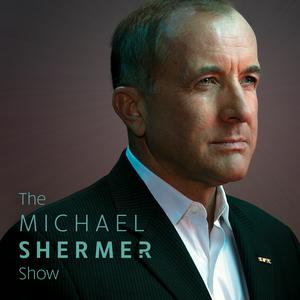
Sobre The Michael Shermer Show
The Michael Shermer Show is a series of long-form conversations between Dr. Michael Shermer and leading scientists, philosophers, historians, scholars, writers and thinkers about the most important issues of our time.
Site de podcastOuça The Michael Shermer Show, O Tempo Virou e muitos outros podcasts de todo o mundo com o aplicativo o radio.net
Obtenha o aplicativo gratuito radio.net
- Guardar rádios e podcasts favoritos
- Transmissão via Wi-Fi ou Bluetooth
- Carplay & Android Audo compatìvel
- E ainda mais funções
Obtenha o aplicativo gratuito radio.net
- Guardar rádios e podcasts favoritos
- Transmissão via Wi-Fi ou Bluetooth
- Carplay & Android Audo compatìvel
- E ainda mais funções

The Michael Shermer Show
Leia o código,
baixe o aplicativo,
ouça.
baixe o aplicativo,
ouça.
 Brasil