
Ouça este podcast gratuitamente no aplicativo: Baixe gratuitamente na App Store
radio.net
Sleeptimer
Guardar rádio
188 episódios
187 - Geoff Hinton & Jay McClelland: Two AI Pioneers in Conversation (RE-AIR)
06/11/2026 | 48minThis re-air episode features Eric's chat with 2024 Nobel Laureate Geoffrey Hinton and Stanford Professor Jay McClelland, two pioneers who have spent nearly half a century laying the groundwork for modern-day AI, advancing research on neural networks long before it captured the world's imagination.
In fact, their early work faced significant skepticism from the scientific community - an experience they candidly discuss in this episode. This wide-ranging conversation covers everything from the capabilities of recent breakthrough LLMS like DeepSeek to AI agents, the nature of memory and confabulation, the challenges to aligning AI with human values when we humans don’t even agree on our values, and Geoff's fascinating new theory of language, featuring an analogy of words as thousand-dimensional, shape-shifting Lego blocks with hands.
Geoff, who retired in 2023, divided his time between the University of Toronto and Google DeepMind. With numerous accolades including the 2018 Turing Award and 2024 Nobel Prize in Physics, he is perhaps best known for co-developing the backpropagation algorithm - now a cornerstone of AI research. Jay, currently at Stanford and Google DeepMind, has revolutionized our understanding of human learning through his work on Parallel Distributed Processing (PDP), applying neural network principles to understand phenomena like language acquisition. His insights into human learning have profoundly influenced how we understand machine learning.
Their friendship dates back to the late 1970s and grew stronger as both collaborated with fellow pioneer David Rumelhart. They share some touching memories about Dave in this episode. Remarkably, despite decades of friendship and building upon each other's work, this appears to be their first recorded conversation together. Eric challenged them to discuss their latest insights and disagreements.
The original episode was recorded on January 29, 2025.
JOIN OUR SUBSTACK! Stay up to date with the pod and become part of the ever-growing community! https://stanfordpsypod.substack.com/
If you found this episode interesting at all, consider leaving us a good rating! It just takes a second but will allow us to reach more people and make them excited about psychology.
Links:
Geoff's website
Geoff's Google Scholar
Jay's website
Jay's Google Scholar
Eric's website
Eric's X @EricNeumannPsy
Podcast X @StanfordPsyPod
Podcast Substack https://stanfordpsypod.substack.com/
Let us know what you think of this episode, or of the podcast! stanfordpsychpodcast@gmail.com186 - Ian Gotlib: Understanding Depression
23/10/2026 | 48minThis week, Katia is joined by Ian Gotlib, a professor of psychology at Stanford University. In this episode, we explore risk factors for depression, its connection to other disorders, and what individuals can do to manage their risk. We also discuss findings from a decade-long study of girls whose mothers have depression, how the way preteens speak may predict internalizing behaviors up to six years later, and how artificial intelligence can advance psychological research.
Ian Gotlib’s Lab Website: https://snaplab.stanford.edu/
Ian Gotlib’s paper, Natural language processing of youth speech predicts psychopathology across adolescence: https://www.nature.com/articles/s44220-026-00683-9
Ian Gotlib: https://www.linkedin.com/in/ian-gotlib-09256526a/
Katia Kriakova: https://www.linkedin.com/in/katiakriakova/
Podcast Twitter: @StanfordPsyPod
Podcast Substack: https://stanfordpsypod.substack.com/
Podcast Contact: stanfordpsychpodcast@gmail.com185 - Brian Knutson: What Neuroscience Reveals About Our Decisions
09/10/2026 | 55minThis week, Katia Kriakova has a conversation with Brian Knutson, a professor of psychology and neuroscience at Stanford University. In this episode, we explore the neuroscience of decision-making, how brain activity can predict behavior and relapse in addiction, and why our choices don’t always align with how we want to live.
Brian Knutson’s LinkedIn: https://www.linkedin.com/in/brian-knutson-8b87762a5/
Brian Knutson’s Lab Website: https://spanlab.stanford.edu/people/brian-knutson/
Katia’s LinkedIn: https://www.linkedin.com/in/katiakriakova/
Podcast Contact: stanfordpsychpodcast@gmail.com
Podcast Twitter: @StanfordPsyPod
Podcast Substack: https://stanfordpsypod.substack.com/184 - Tamar Schapiro: What Philosophy Can(not) Tell us About Children, Adults, and the Root of All Evil
18/09/2026 | 48minIn this week’s episode, Julie and Adani chat with Tamar Schapiro, professor of philosophy at MIT! Tamar is interested in a wide range of things, from what it means to make good decisions in everyday life to ethical theory and the history of ethics (especially Kant and the British Moralists). We discussed Tamar’s work on why we treat children differently from adults, dig into whether and how reactivity might be the root of all evil, and close with some practical life advice based on Tamar’s own journey through philosophy and life!
Tamar’s faculty webpage: https://philosophy.mit.edu/schapiro
Tamar’s recent book, Feeling Like It: a Theory of Inclination and Will: https://doi.org/10.1093/oso/9780198862932.001.0001
Tamar’s paper, Childhood and Personhood: https://access.heinonline.com/HOL/P?h=hein.journals/arz45&i=593
Stanford Encyclopedia of Philosophy entry on The Philosophy of Childhood: https://plato.stanford.edu/entries/childhood/
Julie: https://www.linkedin.com/in/hengj/
Adani: https://www.adaniabutto.com
Podcast Twitter: @StanfordPsyPod
Podcast Substack: https://stanfordpsypod.substack.com/
Let us know what you thought of this episode, or of the podcast! :) stanfordpsychpodcast@gmail.com183 - William Damon: How to Live a Purposeful Life
03/09/2026 | 50minThis week, Katia Kriakova has a conversation with William Damon, a professor at Stanford University. He is one of the world's leading researchers on human development across the lifespan and has pioneered the scientific study of purpose in life. In this conversation, we explore how we can make our own lives more purposeful and expand purpose beyond ourselves.
William Damon’s book on purpose: The Path to Purpose: How Young People Find Their Calling in Life
William Damon’s paper: The Psychology of Purpose: A Comprehensive Approach
William Damon’s LinkedIn: https://www.linkedin.com/in/williamdamon/
Katia Kriakova’s LinkedIn: https://www.linkedin.com/in/katiakriakova/
Podcast Contact: stanfordpsychpodcast@gmail.com
Podcast Twitter: @StanfordPsyPod
Podcast Substack: https://stanfordpsypod.substack.com/
Podcast LinkedIn: https://www.linkedin.com/company/stanford-psychology-podcast/
Mais podcasts de Ciência


Podcasts em tendência em Ciência







Sobre Stanford Psychology Podcast
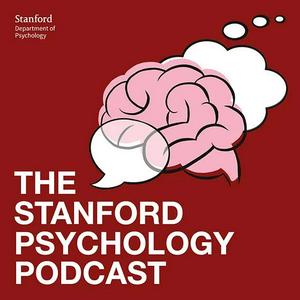
The student-led Stanford Psychology Podcast invites leading psychologists to talk about what’s on their mind lately. Join Eric Neumann, Anjie Cao, Kate Petrova, Bella Fascendini, Joseph Outa and Julia Rathmann-Bloch as they chat with their guests about their latest exciting work. Every week, an episode will bring you new findings from psychological science and how they can be applied to everyday life. The opinions and views expressed in this podcast represent those of the speaker and not necessarily Stanford's. Subscribe at stanfordpsypod.substack.com. Let us hear your thoughts at stanfordpsychpodcast@gmail.com. Follow us on Twitter @StanfordPsyPod. Visit our website https://stanfordpsychologypodcast.com. Soundtrack: Corey Zhou (UCSD). Logo: Sarah Wu (Stanford)
Site de podcastOuça Stanford Psychology Podcast, StarTalk with Neil deGrasse Tyson e muitos outros podcasts de todo o mundo com o aplicativo o radio.net
Obtenha o aplicativo gratuito radio.net
- Guardar rádios e podcasts favoritos
- Transmissão via Wi-Fi ou Bluetooth
- Carplay & Android Audo compatìvel
- E ainda mais funções
Obtenha o aplicativo gratuito radio.net
- Guardar rádios e podcasts favoritos
- Transmissão via Wi-Fi ou Bluetooth
- Carplay & Android Audo compatìvel
- E ainda mais funções

Stanford Psychology Podcast
Leia o código,
baixe o aplicativo,
ouça.
baixe o aplicativo,
ouça.
Stanford Psychology Podcast: Podcast do grupo
 Brasil

