

Ouça este podcast gratuitamente no aplicativo: Baixe gratuitamente na App Store
radio.net
Sleeptimer
Guardar rádio
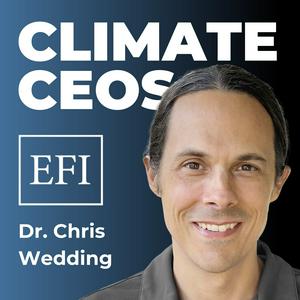
Climate CEOs
Dr. Chris Wedding — Climate Tech CEO Coach | CEO @ EFI
Último episódio
330 episódios
The 40-Year VC Lesson: Relationships Beat Transactions | Brad Feld
09/09/2026 | 55minLegendary venture capitalist Brad Feld, co-founder of Foundry Group and Techstars and author of Give First, explains how founders can use resilience, mentorship, long-term thinking, and non-transactional relationships to build stronger startups and startup communities, especially in climate tech and turbulent markets.
This podcast was so important when we recorded it last year that I'm republishing it now.
Company bio:
Foundry Group is a venture capital firm that invests in technology startups and venture funds across the U.S. Techstars is a global startup accelerator and entrepreneurial network built around mentorship, founder development, and the philosophy of “Give First.”
Speaker bio:
Brad Feld is a legendary venture capitalist, entrepreneur, author, and longtime startup mentor who has spent four decades investing in and advising 4,000+ founders. His book, Give First, explores how non-transactional generosity can strengthen founders, relationships, and startup communities.
Seven things entrepreneurs will learn in this episode:
Why the best founders treat startup near-death experiences as “type 2 fun” and keep adapting when conditions turn against them
Why “Give First” means helping without negotiating the return upfront, not giving endlessly or ignoring your own needs
How to distinguish mentors, advisors, coaches, and investors, and why confusing those roles creates bad expectations
Why healthy boundaries make generosity more sustainable for both founders and mentors
How reputation and relationship capital compound over decades, often producing opportunities you could never have engineered transactionally
Why failed startups still create valuable learning, talent, and technology that can compound across an entrepreneurial ecosystem
Why climate innovation needs positive-sum founder communities that share knowledge and support each other through shifting markets, politics, and funding cycles
--
Join our confidential CEO community.
Private CEO group for VC/PE-backed climate tech founders navigating capital, strategy, and scale. Capped at 45 CEOs and 45 Mentors (investors and post-exit CEOs), representing $40B in enterprise value or investment capital.
→ entrepreneursforimpact.com
Join 40,000 professionals who get our free newsletter.
Climate tech finance, strategy, leadership. 2-min read.
→ entrepreneursforimpact.substack.com
Leave a 20-second podcast review.
If you found it valuable, be a climate community builder and rate, review, or follow the podcast on Apple and Spotify. It helps push more capital and talent toward scalable climate solutions.The Climate Tech Map: Where Capital and Innovation Are Still Missing | Speed & Scale, Doerr Capital
01/09/2026 | 48minClimate tech is scaling fast. But the data shows huge gaps in industrial decarbonization, carbon removal, energy storage, and the capital needed to turn breakthrough technologies into profitable businesses.
Company bio:
Speed & Scale is a climate action initiative built around measurable objectives and key results (OKRs) for reaching net-zero emissions, originating from John Doerr’s Speed & Scale framework.
https://speedandscale.com
Its Climate Tech Map, developed with partners including Breakthrough Energy, Elemental Impact, Energy Innovation, McKinsey Sustainability, and Stanford’s Doerr School, organizes thousands of climate technologies into a navigable roadmap of decarbonization opportunities.
https://climatetechmap.com
Guest bios:
Ryan Panchadsaram is co-author of Speed & Scale and an investor at Doerr Capital, where his work spans climate technology investing, philanthropy, and climate strategy; his earlier career includes entrepreneurship and public-sector leadership.
Quinn is Director of Research at Speed & Scale, and an investor at Doerr Capital, where she helps translate complex climate, technology, and market data into actionable frameworks for investors, entrepreneurs, policymakers, and professionals entering climate tech.
Seven things you’ll learn in this episode:
Why steel, cement, and food may offer more climate-tech whitespace than the crowded energy sector.
Why climate technologies need a green discount, not just cost parity.
How deep tech founders can prove their path from expensive prototype to profitable scale.
Why manufacturing talent often needs to join a climate startup earlier than founders expect.
Why long-duration energy storage is emerging as a major investment opportunity.
Where climate capital is surging—and where promising technologies are still starved for funding.
Why successful leaders should spend more time creating than consuming.
--
Join our confidential CEO community.
Private CEO group for VC/PE-backed climate tech founders navigating capital, strategy, and scale. Capped at 45 CEOs.
→ entrepreneursforimpact.com
Join 40,000 professionals who get our newsletter.
Climate tech finance, strategy, leadership. 2-min read.
→ entrepreneursforimpact.substack.com
Leave a podcast review.
If you got value, take 30 seconds and do the community a favor. It helps push more capital and talent toward scalable climate solutions.The CEO Vulnerability Paradox | Strong ≠ Invincible
28/08/2026 | 6minClimate CEOs are expected to project confidence. But acting invincible can make investors, employees, and customers trust you less.
This minisode explores the "vulnerability paradox" and why selective candor can be a leadership advantage.
Confidence and vulnerability aren’t opposites — CEOs need to project conviction, especially during fundraising, layoffs, missed milestones, and difficult customer negotiations. But pretending everything is perfect can undermine credibility.
People connect through shared struggle — Investors, employees, and customers respond to leaders who acknowledge that building companies is messy. The perfectly scripted founder story rarely feels believable.
Share challenges selectively — Vulnerability doesn’t mean telling everyone everything. Share the right mistakes, lessons, and unresolved challenges with the right audience.
Replace perfection with learning — “Here’s what we’re learning” can build more trust than pretending everything is going according to plan.
Candor can be commercially valuable — Trust matters in fundraising, hiring, partnerships, and enterprise sales. Sometimes admitting uncertainty strengthens the relationship instead of weakening it.
The core lesson — Strong CEOs don’t need to look invincible. They need to know when confidence builds trust, and when honesty builds more.
👉 Get the written summary:
https://entrepreneursforimpact.substack.com/p/climate-ceos-stop-acting-invincible
--
1️⃣ Join our confidential CEO community.
Private CEO group for VC/PE-backed climate tech founders navigating capital, strategy, and scale. Capped at 45 CEOs.
→ entrepreneursforimpact.com
2️⃣ Join 40,000 professionals who get our newsletter.
Climate tech finance, strategy, leadership. 2-min read.
→ entrepreneursforimpact.substack.com
3️⃣ Leave a podcast review.
If you got value, take 30 seconds and do the community a favor. It helps push more capital and talent toward scalable climate solutions.How to Get 30% More Power From Existing Nuclear Plants | Alva Energy
25/08/2026 | 52minWhat if America could add gigawatts of nuclear power without building new nuclear plants? Alva Energy is upgrading existing reactors to produce 20–30% more power, potentially adding 200–300 megawatts per plant in just 3–5 years.
Company bio:
Alva Energy is developing technology to increase the output of existing nuclear power plants by upgrading their nuclear steam systems and adding a second turbine generator. The company is already working exclusively with six operating reactors, and estimates projects could add roughly 200–300 MW for around $1B, less than one-fifth the cost of new nuclear construction.
Speaker bio:
James Krellenstein is the co-founder and CEO of Alva Energy. A physicist by training and the son of a nuclear engineer and energy economist, James combines nuclear technology, project finance, and first-principles thinking. Alva has raised a $32M Series A led by former Intel CEO Pat Gelsinger with Playground Global.
Five lessons for entrepreneurs:
Look for billion-dollar opportunities hiding in plain sight – Alva’s core nuclear uprate approach had already been demonstrated in Sweden. The opportunity came from understanding why it hadn’t scaled in the US—and redesigning around that bottleneck.
Go to the source material – James traces part of Alva’s technical insight to reading a 15,000-page nuclear engineering filing. Secondary summaries are convenient; sometimes the best opportunities are buried several layers deeper.
Design the financing alongside the technology – Alva separates its venture-backed TopCo from individual project companies that can use project debt and equity. The goal is to make nuclear upgrades financeable like other infrastructure assets.
Don’t let venture capital’s obsession with speed destroy execution – Demand grew faster than Alva expected, reaching engineering exclusivity with six reactors in under two years. James has deliberately tapped the brakes when necessary because nuclear engineering quality matters more than locking up TAM.
Align incentives around getting projects built – Instead of relying on traditional time-and-materials contracts that can reward higher project costs, Alva uses fixed-price structures and invests alongside project investors. Everyone benefits from bringing projects online faster and cheaper.
--
1️⃣ Join our confidential CEO community.
Private CEO group for VC/PE-backed climate tech founders navigating capital, strategy, and scale. Capped at 45 CEOs.
→ entrepreneursforimpact.com
2️⃣ Join 40,000 professionals who get our newsletter.
Climate tech finance, strategy, leadership. 2-min read.
→ entrepreneursforimpact.substack.com
3️⃣ Leave a podcast review.
If you got value, take 30 seconds and do the community a favor. It helps push more capital and talent toward scalable climate solutions.The Climate CEO’s Method for Hiring A-Players
21/08/2026 | 11minMost hiring mistakes don’t happen because CEOs can’t recognize talent. They happen because interviews reward candidates who are good at interviewing.
This minisode explores a more rigorous method for hiring executives (topgrading), and how climate CEOs can uncover performance patterns before making an expensive mistake.
Look for patterns, not polish — Walk through a candidate’s career job by job to understand what they accomplished, where they struggled, why they left, and what patterns repeat.
Ask the same questions about every role — What were you hired to do? What did you accomplish? What were the low points? Why did you leave? Consistency makes comparisons easier and exposes gaps.
Use the Threat of Reference Check — Ask candidates what each former boss will say about their performance. Knowing you may verify the answer tends to produce more candid responses.
Test for startup fit, not just executive credentials — A successful Fortune 500 executive may struggle when the job requires getting into the weeds during a funding round, factory scale-up, or major customer deployment.
Spend more time before the hire — A rigorous interview process takes longer upfront. But that cost is tiny compared with losing six months to the wrong executive and starting the search again.
The core lesson — Your goal isn’t to hire the best interviewer. It’s to find evidence that someone has repeatedly produced the results you need in environments similar to yours.
👉 Get the written summary:
https://entrepreneursforimpact.substack.com/p/the-climate-ceos-method-for-hiring
--
1️⃣ Join our confidential CEO community.
Private CEO group for VC/PE-backed climate tech founders navigating capital, strategy, and scale. Capped at 45 CEOs.
→ entrepreneursforimpact.com
2️⃣ Join 40,000 professionals who get our newsletter.
Climate tech finance, strategy, leadership. 2-min read.
→ entrepreneursforimpact.substack.com
3️⃣ Leave a podcast review.
If you got value, take 30 seconds and do the community a favor. It helps push more capital and talent toward scalable climate solutions.
Mais podcasts de Empreendedorismo
 ResumoCast | Livros para EmpreendedoresEmpreendedorismo, Negócios
 The Prof G Pod with Scott GallowayEmpreendedorismo, Negócios
 Investidor Sardinha por Raul SenaEmpreendedorismo, Negócios
 FoundersEmpreendedorismo, História, Negócios, Tecnologia
 MF CastEmpreendedorismo, Negócios
 PodAcelerar - Empreendedorismo e NegóciosEmpreendedorismo, Negócios
 Like a BossEmpreendedorismo, Negócios, Tecnologia
 Kritikê PodcastEmpreendedorismo, Negócios
Podcasts em tendência em Empreendedorismo


Sobre Climate CEOs
The leading weekly briefing for climate founders and CEOs. Hosted by Dr. Chris Wedding, executive coach and CEO of Entrepreneurs for Impact (EFI), a peer group capped at 90 CEOs & investors representing $40B in enterprise value and assets under management. Climate CEOs delivers playbooks from the front lines of climate tech, with insights on raising capital, scaling startups in clean energy, batteries, carbon capture, and the circular economy, plus the founder mindset, mindfulness, daily habits, book recommendations, and resilience needed to thrive.
Site de podcastOuça Climate CEOs, Tony Robbins Podcast Daily e muitos outros podcasts de todo o mundo com o aplicativo o radio.net
Obtenha o aplicativo gratuito radio.net
- Guardar rádios e podcasts favoritos
- Transmissão via Wi-Fi ou Bluetooth
- Carplay & Android Audo compatìvel
- E ainda mais funções
Obtenha o aplicativo gratuito radio.net
- Guardar rádios e podcasts favoritos
- Transmissão via Wi-Fi ou Bluetooth
- Carplay & Android Audo compatìvel
- E ainda mais funções

Climate CEOs
Leia o código,
baixe o aplicativo,
ouça.
baixe o aplicativo,
ouça.
Climate CEOs: Podcast do grupo
 Brasil