PodcastsNegóciosBuilt for Turbulence

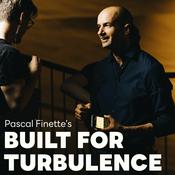
Built for Turbulence

Pascal Finette
Built for Turbulence
Último episódio

61 episódios

  • Built for Turbulence

    Command and Control Makes Leaders Stupid — Peter Laughter on Why the Pyramid Is Crumbling

    13/2/2026 | 39min
    “As we move up the pyramid of command and control, people stop telling us the truth. We as leaders actually become dumber.” – What if everything you learned about leadership is based on a system designed for sovereigns managing illiterate peasants?
    In this episode, Peter Laughter – a recovering CEO, Quaker, and self-described student of human connection – challenges the foundations of how we lead organizations. Drawing from his own transformation (from anxiety-ridden command-and-control leader to champion of distributed power), Peter lays out a radically different vision: one where your job as a leader isn’t to have the answers, but to make sure the people who do can actually speak up.
    What You’ll Discover:
    [00:00] Why Disruption Is Just Evolution – And Why We Keep Fighting It
    → The biological case for why struggle is the feature, not the bug – and why the gap between technological waves has collapsed
    [06:00] The Deming Effect: How Market Forces Will Force Leadership Change
    → Why big organizations can’t change from within, and how a wave of AI-displaced workers will build something better from scratch
    [12:00] Why Bayer’s Top-Down Decentralization Might Be Doomed
    → The critical difference between mandating a system and growing one – and lessons from Zappos’ Holacracy disaster
    [18:00] The Becky Moment: When an Employee Called Out Her CEO’s Core Values Violation
    → Peter’s personal turning point – how getting overruled by a team member killed his anxiety and changed his entire leadership philosophy
    [24:00] How to Actually Start: The “What Are You Seeing?” Framework
    → A dead-simple Monday-morning practice that shifts you from having the plan to gathering perspectives
    [30:00] Why Consensus Is Violence and Decisions Should Be Made by Framework
    → How Peter built a values-based decision system where employees could challenge the CEO – and why it produced better outcomes
    [36:00] Recruiting Is Broken: Why You Should Hire Happy People, Not Desperate Ones
    → Why starting the recruiting process before you need someone completely changes who you attract
    [40:00] The Misconception That Hurt Most: “I Was Supposed to Be The One”
    → Peter’s answer to what he got wrong – and why he’s optimistic about the future despite everything
    Key Takeaways:
    Command and control doesn’t just limit organizations – it actively makes leaders dumber by cutting off honest feedback
    You don’t need everyone on board to change an organization – 20-30% creates a cascade (Greg Satel’s Cascades model)
    Start any leadership challenge by asking “What are you seeing?” and actually listening for the brilliance in the answer
    Replace consensus (which beats ideas down to the least common denominator) with values-based decision frameworks
    The gap between idea and reality is now nearly zero – and that changes everything about who can build what
    About Peter:
    Peter is a former CEO turned leadership advisor whose work centers on what he calls “abundant leadership” – the recognition that power and authority are fluid, not fixed. Rooted in Quaker decision-making principles and real-world experience building distributed organizations, he helps leaders create environments where emergent leadership can thrive.
  • Built for Turbulence

    Why Your AI Shouldn’t Be a Chatbot: Jeff Seibert on Building AI-Native Companies That Actually Work

    26/11/2025 | 35min
    “Why do I have to tell your chatbot to do something? Just do it.”
    In this episode, Jeff Seibert – founder of Digits (AI-native accounting platform), former Twitter Head of Product, and the engineer behind Crashlytics (now on 6 billion devices) – reveals what it actually takes to build AI-native companies from scratch. We explore why most companies are getting AI wrong by bolting chatbots onto old products, how to structure teams for extreme velocity, and why the accounting industry is about to experience its HP-35 calculator moment. Jeff’s bold prediction: the entire month-end close process will be automated within 12 months.

    What You’ll Discover:
    [02:45] Why Accounting Data Quality is Decades Behind Product Analytics → The genesis story of Digits: when Twitter’s 100-person finance team couldn’t answer a simple budget question in under three weeks
    [08:28] Building Companies for AI From Day One → How ML-native architecture differs from traditional databases and why this matters more than the AI hype suggests
    [10:31] The 65-Person Company That Runs All-Hands Every 48 Hours → Jeff’s radical approach to velocity: weekly sprints, fractal team structures, and why they’ll never hire “lone eagle” engineers
    [15:20] Keeping Teams Intentionally Small at Scale → How to eliminate the “empire building” problem by dissociating engineering coaches from project staffing
    [19:59] What CEOs Actually Do That AI Can’t Replace (Yet) → The 10%/90% leadership philosophy and why Sundar Pichai’s “AI will replace CEOs” take misses the point
    [23:30] Disrupting QuickBooks: Technology vs. Distribution → Why accounting is uniquely suited for AI disruption and how startups can outpace 800-pound gorillas
    [26:14] Why AI Isn’t Just Another Ajax Moment → The fundamental shift from “talk to our chatbot” to “the AI should just do it” – and what that means for software architecture
    [30:47] The Architectural Wall Ahead for Large Language Models → Why current LLM architecture won’t reach AGI: the context window problem, lack of memory, and inability to backtrack during inference
    [32:05] The Great Work Displacement: Data Entry is Dead by 2026 → Jeff’s evolved prediction on AI’s economic impact and why the “lump of labor fallacy” applies to automation fears

    Key Takeaways:
    AI-native means redesigning your data architecture from scratch, not adding a chatbot interface to legacy systems
    Run your company on the shortest planning horizon you can see – for Digits, that’s 4-5 week “horizons”
    Hire senior people who are “chill” with strong opinions, loosely held – and actively filter out solo operators
    The most powerful AI products won’t ask users what to do – they’ll understand the goal and just execute
    Accounting’s month-end close will be automated by end of 2025, marking one of AI’s first complete workflow eliminations

    About Jeff Seibert:
    Jeff is the founder and CEO of Digits, the AI-native accounting platform. Previously, he served as Twitter’s Head of Consumer Product (launching the algorithmic timeline), co-founded Crashlytics (acquired by Twitter, now runs on 6 billion smartphones), and was featured in Netflix’s Emmy-winning documentary “The Social Dilemma.” He’s backed 100+ startups as an angel investor and has been building software since releasing his first app at age 12.

    Related Links:
    Digits
  • Built for Turbulence

    We Couldn’t Rebuild Our Own Success Today: HP Fellow Will Allen on Why Big Companies Kill Innovation, Research vs Development, and Bringing AI to the True Edge

    10/11/2025 | 39min
    “We couldn’t start inkjet again if we had it in our hands because we’re not meeting the rules.” That stark admission from former HP Fellow Will Allen reveals why even the most innovative companies struggle to recreate their own breakthroughs—and what it takes to actually scale disruptive technology.
    In this episode, Will Allen, holder of 102 US patents and the first HP Fellow promoted within HP’s Global Print Business, takes us inside three decades of Silicon Valley innovation from logic analyzers to consumer inkjet printing to his current role as CTO at Kaspix, where he’s pioneering ultra-low-power AI inference using analog circuits. We explore why research should be treated as investment portfolio management (not an expense to cut), how “showing beats telling” when getting buy-in for radical ideas, and why getting AI to the “true edge” – directly at sensors and actuators – will fundamentally change computing economics.
    What You’ll Discover:
    [00:00] Why Research and Development Are Two Different Things
    → The fatal mistake of treating R&D as a single expense line when research is actually an investment with portfolio-level returns
    [06:03] Has Silicon Valley Run Out of Ideas?
    → Why scaling success creates the very constraints that prevent future innovation, and whether we’re less innovative than decades past
    [10:12] The Scaling Trap That Kills Success
    → Real HP story: how field-fixing problems scaled so badly that engineers couldn’t design problems out, and what this means for any growing business
    [16:23] Getting Past the “$100 Million Question”
    → How to navigate corporate demand for predictable returns when developing something the market has never seen before
    [18:03] “A Functioning Proto Is Worth a Thousand Pictures”
    → The clownfish story: how a weekend demo got low-drop-volume printing approved after months of rejection, and the art of communicating on stakeholders’ terms
    [21:16] Signal Spotting and Fundamental vs Killer Apps
    → Will’s framework for distinguishing noise from transformational trends—and why asking “what’s the killer app?” might be the wrong question
    [24:47] Kaspix and the True Edge
    → Why analog circuits for AI inference could be as transformative as the mouse, enabling intelligence directly at transducers without memory-compute bottlenecks
    [29:56] Where AI Is Actually Heading
    → Beyond the hype: specialized AIs, “AI middle management,” and why rapid societal change from deterministic technology creates uncomfortable transitions
    [36:04] The Advice Will Would Give His Younger Self
    → Why leaders who invested years in education suddenly think quarterly, and how to reclaim the long-term thinking that got you there

    About Will Allen:
    Will Allen is CTO at Kaspix, pioneering ultra-low-power AI inference through analog circuit design. Previously, he spent 30 years at HP, becoming the first HP Fellow promoted within HP’s Global Print Business. He designed the color imaging pipeline used in HP’s first 4 million color consumer inkjet printers, led IP production in HP Labs’ AI and Emerging Compute Lab, and holds 102 issued US patents across printing, displays, robotics, and digital imaging.

    Related Links:
    Will’s LinkedIn Profile
    Will’s Professional Homepage
    Will’s YouTube Channel
    Kaspix
    Kaspix Founder Pablo Zegers interviewed on The Innovators Podcast by John Biggs
  • Built for Turbulence

    Navigating Uncertainty: Learning, Leadership, and AI's Real Role with Jeffrey Rogers

    08/10/2025 | 43min
    What if the leadership frameworks we’ve relied on for decades are fundamentally broken for today’s world? In this thought-provoking conversation, Pascal sits down with Jeffrey Rogers—his collaborator of nearly a decade—to explore how leaders can navigate sustained uncertainty and systematic disruption.
    Jeffrey, an expert in organizational learning and futures thinking, challenges the “Good to Great” era of one-size-fits-all leadership models. Instead, he advocates for meta-learning: the ability to learn how to learn, adapt frameworks contextually, and build organizations that can transform repeatedly. They dive deep into the tension between efficiency and experimentation, why the “middle horizon” (5-10 years) is so hard to envision, and how generative AI fits into organizational learning—spoiler: it’s not the efficiency tool you think it is.
    Key Topics Covered:
    Why best practices are dead and what replaces them in high-uncertainty environments
    The efficiency vs. learning paradox: how to balance execution with experimentation
    Generative AI’s real value: rapid prototyping, not scaling (and why that matters)
    The futures cone and how to think about multiple possible futures
    Practical advice for middle managers when leadership won’t listen
    Building learning systems that connect across your organization
  • Built for Turbulence

    The Future of HR: Insights from Gero Hesse on AI's Impact, Authentic Leadership, and Human-Centric Culture

    27/8/2025 | 31min
    In this episode, we are joined by Gero Hesse, a distinguished “Top HR Influencer” and CEO of EMBRACE, a Bertelsmann Investments company at the forefront of HR technology. Drawing from his deep expertise, Gero offers a profound perspective on how the HR industry must evolve in an era defined by constant change. The conversation delves into the pressing dichotomy of the talent shortage driven by demographic shifts versus the narrative that AI will automate countless jobs. Gero argues that while technology will inevitably replace administrative roles, it will simultaneously create new ones, shifting the core challenge to workforce transformation and reskilling. He envisions a future where HR transitions from an administrative function to a strategic one, responsible for shaping the cultural and ethical rules for a new, blended workforce of humans and machines.
    Gero also shares his personal leadership philosophy, which is anchored in radical authenticity and a commitment to building long-term, trust-based relationships. He believes in being the same person at work and in his private life, a principle visibly reflected in the edgy, unconventional branding of his company and its festival-style conferences. Ultimately, Gero provides clear guidance for leaders and HR professionals: as automation handles routine tasks, the enduring value of HR will lie in its ability to manage the human side of the business. He champions a future where the focus shifts to shaping culture, fostering employee identification, and guiding technology integration in a way that amplifies human potential rather than simply replacing it.

Mais podcasts de Negócios

Sobre Built for Turbulence

Uncertainty isn’t going away – so let’s learn to thrive on it. Join Pascal Finette (author of Disrupt Disruption, GYSHIDO, and Built for Turbulence [2026]) in conversations with leaders who’ve built organizations that get stronger under stress. No theory. No consultant-speak. Just practical wisdom from practitioners in the trenches – turning volatility into competitive advantage and building antifragility into everything they do. Each episode: real stories, hard-won insights, and actions you can take Monday morning. The future belongs to those who prepare, not predict.
Site de podcast

Ouça Built for Turbulence, Braincast e muitos outros podcasts de todo o mundo com o aplicativo o radio.net

Obtenha o aplicativo gratuito radio.net

  • Guardar rádios e podcasts favoritos
  • Transmissão via Wi-Fi ou Bluetooth
  • Carplay & Android Audo compatìvel
  • E ainda mais funções

Built for Turbulence: Podcast do grupo

Informação legal
Aplicações
Social
v8.5.0 | © 2007-2026 radio.de GmbH
Generated: 2/14/2026 - 1:56:42 AM