PodcastsGestãoWorld's Greatest Business Thinkers

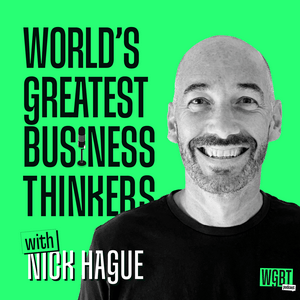
World's Greatest Business Thinkers

Nick Hague
World's Greatest Business Thinkers
Último episódio

48 episódios

  • World's Greatest Business Thinkers

    #47: Cut the Noise, Keep the Signal: Fixing Work Friction with Robert Sutton

    08/04/2026 | 1h 9min
    What if the biggest drain on your team's productivity isn't lack of effort, but the friction you've built into your systems?
    In this episode of World's Greatest Business Thinkers, host Nick Hague speaks with Robert Sutton, Organizational Psychologist, and Professor Emeritus at Stanford, about the hidden cost of organizational friction. Robert explains how leaders can act as "friction fixers," removing bureaucratic barriers, unnecessary meetings, and email overload while preserving productive constraints that improve decision-making. 
    The conversation explores practical frameworks like the "subtraction game," strategies to combat performative leadership, and the importance of treating others' time as a sacred resource. With real-world examples from companies like Google, Sutton also unpacks how AI can either streamline or worsen broken systems depending on how thoughtfully it's applied.
    What You Will Learn:
     How to distinguish good friction from bad friction

     The "subtraction game" framework for identifying organizational waste

     Why treating others' time as a sacred trust is the foundation of leadership

     How to combat "peacocking" and the "smart talk trap" in your organization

     The power of constraint-based rules to eliminate bad friction at scale

     Why AI is a magnifying glass for both good and bad processes

     
    If you enjoyed this episode, make sure to subscribe, rate, and review it on Apple Podcasts, Spotify, and YouTube Podcasts. Instructions on how to do this are here.
     
    About Guest:
    Robert Sutton is an organizational psychologist and Professor Emeritus at Stanford University's School of Engineering, where he has spent over 40 years studying how organizations function at scale. Known for his bestselling books, including *The No Asshole Rule* and *The Friction Project: How Smart Leaders Make the Right Things Easier and the Wrong Things Harder*, Robert bridges the gap between academic research and real-world organizational challenges. His work focuses on creating organizations that are both humane and financially viable, examining how leaders can intentionally design systems to eliminate bad friction while preserving good friction.
     
    Quotes:
    "Bad friction is stuff that gets in the way of doing the work you should be doing. But there are all these things that should be slower, difficult, or impossible; doing things that are unlawful should be impossible. We're interested in both good friction and bad friction, and I probably spend 80% of my time talking about bad friction."

    "Email is the killer app of the Internet in two ways: it was winning the Internet, and it was killing people. This is 2026, and there's all this software, all the AI, Slack, and all these different ways to communicate, but email remains the killer app in both senses."

    "The first step is having a leader who talks about and takes action to have people identify and talk publicly about things that are in the way that make it hard to get their work done. When a leader creates real psychological safety, it's amazing that people will get in this mindset of, 'What are we doing that could get in the way?'"

    "Peacocking is when people do things for status display so they don't actually have to do the hard work of implementing something. People will get ahead for saying smart things rather than doing things, but coming up with a plan or announcing an initiative is great; you actually have to do something."

     
    Keywords:
    Primary Keywords (Core Themes): friction management, organizational psychology, leadership strategy, workplace efficiency, bad friction vs good friction, reducing organizational friction, friction fixing, leadership in action, organizational culture, management practices
     
    Secondary Keywords (Related Subtopics): psychological safety, bureaucratic processes, email overload, meeting efficiency, peacocking in business, smart talk trap, subtraction strategy, process improvement, organizational scaling, decision-making speed, change management, workplace innovation
     
    Episode Resources:
     Robert Sutton on LinkedIn

    Stanford University School of Engineering Website 

    World's Greatest Business Thinkers on Apple Podcasts

    World's Greatest Business Thinkers on Spotify

    World's Greatest Business Thinkers on YouTube
  • World's Greatest Business Thinkers

    #46: Why Culture Beats the Best Marketing Strategy: A Deep Dive with Dr. Marcus Collins

    25/03/2026 | 1h
    What if culture and not demographics or marketing strategies is the ultimate driver of human behavior and business success?
    In this episode of World's Greatest Business Thinkers, host Nick Hague speaks with cultural scholar, best-selling author, advertising strategist, and Professor of Marketing at Michigan University,  Dr. Marcus Collins. Marcus explains why culture, not demographics or tactics, is the true driver of human behavior and business success. He explores how brands grow by aligning beliefs, behaviors, and creations with the communities they serve, rather than chasing trends or forcing top-down messaging. 
    The conversation highlights the importance of authenticity, cultural empathy, and community listening in building meaningful brands. Leaders will learn how organizations can foster genuine cultural connections and why facilitating existing meaning matters more than manufacturing it.
    What You Will Learn:
    Why culture eats strategy for breakfast

    How to distinguish cultural relevance from mere popularity

    The critical difference between top-down messaging and community building.

    How to measure cultural embeddedness in your organization and market

    Why authenticity is non-negotiable and easily detected

    The power of leaving strategic gaps for audiences to fill

    How to leverage cultural intimacy to stay ahead of market shifts

     
    If you enjoyed this episode, make sure to subscribe, rate, and review it on Apple Podcasts, Spotify, and YouTube Podcasts. Instructions on how to do this are here.
     
    About Guest
    Dr. Marcus Collins is a Professor of Marketing at the University of Michigan and a cultural strategist whose work bridges academia and practice by exploring how culture shapes human behavior and business outcomes. With a background spanning music production, digital strategy for global artists (including Beyoncé), and advertising leadership at agencies like Wieden+Kennedy and Translation, he brings a rare blend of creative and scholarly expertise. He is also the author of *For the Culture*, a groundbreaking exploration of how cultural meaning-making supersedes demographics in driving consumer loyalty and organizational success.
     
    Quotes:
    "There is no external force more influential to human behavior than culture, full stop. It is the governing operating system of humanity. Culture is a system of conventions and expectations that demarcate who we are and govern what people like us do."

    "If you ask someone five years ago which car company was going to change the industry, most likely people would say Tesla. But if you ask people a year ago, that would not be the case. It's because of the meanings that people have assigned to Tesla and Elon Musk, because of these meanings, the car takes on a different form in their minds."

    "We so often use the word culture as a shortcut for popularity, but they aren't the same. Popularity is centered on the familiarity of a thing, but culture centers on meaning. Brands that are culturally relevant tend to grow six times more than brands that are not."

    "Companies will tell us that a thing is cool, companies will tell us that it's the best, but people ultimately decide whether we are or not. It's the people who decide what's acceptable, not the top-down directives from corporations."

     
    Keywords:
    Primary Keywords (Core Themes):
    Culture and behavior, Cultural meaning-making, Brand culture strategy, Consumer identity and culture, Cultural relevance marketing, How culture influences decisions, Cultural operating system, Meaning-making systems, Cultural communities, Brand loyalty through culture
     
    Secondary Keywords (Related Subtopics):
    Popular vs. cultural distinction, Cultural embeddedness, Bottom-up vs. top-down marketing, Community building and fandom, Authenticity in brand participation, Organizational culture alignment
     
    Episode Resources:
    Dr. Marcus Collins on LinkedIn

    University of Michigan Website 

    World's Greatest Business Thinkers on Apple Podcasts

    World's Greatest Business Thinkers on Spotify

    World's Greatest Business Thinkers on YouTube
  • World's Greatest Business Thinkers

    #45: Breaking the Bureaucratic Machine: Reinventing Organizational Management Theory with Gary Hamel

    11/03/2026 | 1h 6min
    What if the organizational structures designed to scale your business are actually holding it back?
    In this episode of World's Greatest Business Thinkers, host Nick Hague speaks with renowned management theorist, Visiting Professor at London School of Business, and best-selling author, Gary Hamel, about how bureaucracy in organizations undermines innovation, engagement, and performance. Hamel argues that rigid organizational structures and excessive business hierarchy drain trillions from the global economy and prevent companies from unlocking human potential. 
    The conversation explores how decentralization in business, team empowerment, and bold management strategy can restore organizational agility. Drawing on examples from companies like Roche, Nucor, and Haier, Hamel explains why employee engagement, not efficiency, is the ultimate measure of success in modern organizational management.
    What You Will Learn:
    How to identify bureaucratic drag in your organization

    Why reducing management layers is non-negotiable

    The three conditions that eliminate the need for excessive management

    How to push authority down without creating chaos

    Why employee engagement is the single metric that matters most

    How to drive change without owning the system

     
    If you enjoyed this episode, make sure to subscribe, rate, and review it on Apple Podcasts, Spotify, and YouTube Podcasts. Instructions on how to do this are here.
     
    Gary Hamel Bio:
    Gary Hamel is a renowned organizational management thinker, bestselling author, and Visiting Professor of Strategy and Entrepreneurship at London Business School, where he has taught since 1983. Widely regarded as one of the world's most influential business strategists, he has pioneered concepts such as strategic intent, core competence, and management innovation. Hamel is the author of several global bestsellers, including Humanocracy and The Future of Management, and his work has reshaped how leaders think about innovation, organizational design, and the future of management. 
     
    Quotes:
    "All of these companies, irrespective of culture or industry or geography, all of them suffered from similar disabilities. They were kind of congenitally timid, they weren't very innovative, and they were soulless places to work. When you see the same set of disabilities or maladies again and again, you realize it's not about one leader or one company or a strategy, there's something much deeper going on."

    "We need entrepreneurship at scale, and I need speed at scale, and I need boldness at scale. And that old management model was just inimical to those."

    "I've never yet seen an organization with eight or nine management layers that is nimble and innovative."

    "We are wasting colossal sums of human imagination and initiative. Only 20% of people around the world are engaged in their work, and only one in five employees believes their ideas matter at work. The only way out of that is we gotta turn on all that unused intellectual capacity."

     
    Keywords:
    Primary Keywords (Core Themes): bureaucracy in organizations, organizational management, business innovation, management strategy, organizational structure, employee engagement, leadership transformation, corporate culture, business hierarchy, management theory
    Secondary Keywords (Related Subtopics): removing bureaucratic layers, decentralization in business, organizational agility, management innovation, corporate transformation, autonomy in the workplace, team empowerment, organizational efficiency, knowledge economy management, institutional vitality
     
    Episode Resources:
    Gary Hamel on LinkedIn

    London Business School Website 

    World's Greatest Business Thinkers on Apple Podcasts

    World's Greatest Business Thinkers on Spotify

    World's Greatest Business Thinkers on YouTube
  • World's Greatest Business Thinkers

    #44: From Good to World-Class: The Power of Micro Habits with Damian Hughes

    25/02/2026 | 1h 17min
    What if the secret to breakthrough performance wasn't a dramatic overhaul, but a series of small, consistently applied changes?
    In this episode of World's Greatest Business Thinkers, host Nick Hague speaks with Damian Hughes, author of Micro Habits, co-host of the High Performance podcast, and England rugby coach, about the power of small, consistent actions in building extraordinary results. Drawing on insights from over 500 elite performers, from Formula 1 champion Lando Norris to Michelin-starred chef Will Guidara, Hughes explains why culture, identity, and purpose outperform dramatic reinvention. He unpacks the Job-Career-Calling framework, the "Best Friend Test," and the "Batman Effect," revealing how micro habits shape resilience, engagement, and high-performing teams. Success, he argues, is engineered daily, one deliberate choice at a time.
    What You Will Learn:
    How to reframe any task to unlock higher engagement and effectiveness

    The "Best Friend Test" method for discovering your authentic purpose

    Why "we not me" cultures outperform ego-driven organizations

    The psychology of not "sweating the small stuff."

    The Batman Effect: how an aspirational identity shifts you from reactive panic to strategic response

    How to establish micro habits despite resistance

     
    If you enjoyed this episode, make sure to subscribe, rate, and review it on Apple Podcasts, Spotify, and YouTube Podcasts. Instructions on how to do this are here.
     
    Damian Hughes Bio
    Damian Hughes is a bestselling author, speaker, and visiting Professor of Organisational Behaviour and Change at Manchester Metropolitan University. Blending sport, psychology, and organisational development, he helps teams build high-performing cultures. He has written eight business books, including High Performance, a Sunday Times number one bestseller, with his work translated into twelve languages. Co-host of The High Performance Podcast, with over 250 million downloads, Damian has coached elite international teams and founded The School Coat Charity, supporting children in poverty.
     
    Quotes:
    "They're all small to do, they're all really quick to understand, and they're really simple to be able to get your head around. So I started going back through the archive of 500 guests, and in every one of them, you would find at least one or two ideas that were central to it. The more I looked at it through that lens of what are the small things that these people are doing that any of us could adopt, that's where the micro habits idea came from."

    "When you meet people who have achieved incredible things, you think it's about talent or money or connections, but what you realize when you look closest is it's boring stuff, the boring stuff of showing up every day and doing these habits that bring a reward. It's not about big leaps or great shows of courage; it's often done in really small, simple, but consistently applied habits."

    "Every task you do can either be viewed as just a job, just a career, or just a calling. If you view it as a calling, you do it because you love it and it fits your identity. It's the same task you're doing, but the way you choose to interpret it makes your levels of happiness, effectiveness, and ability to engage with others increase."

    "The real answer to 'why are you my mate' almost doesn't have words, it's the emotional part of the brain. You have to keep pushing because what we often try to do is put words to emotions that don't have a vocabulary. Eventually, they will articulate something that is an emotion you evoke, and then you think about how to structure your life around that."

     
    Keywords:
    Primary Keywords (Core Themes): micro habits, high performance culture, personal development, business leadership, habit formation, consistency and momentum, performance psychology, elite sports coaching, organizational behavior, self-improvement strategies
    Secondary Keywords (Related Subtopics): job crafting, calling versus career, purpose-driven work, team dynamics, we versus me mentality, customer experience, hospitality culture, resilience in adversity, responding versus reacting, identity-based habits
     
    Episode Resources:
    Damian Hughes on LinkedIn

    Nick Hague on LinkedIn

    World's Greatest Business Thinkers on Apple Podcasts

    World's Greatest Business Thinkers on Spotify

    World's Greatest Business Thinkers on YouTube

  • World's Greatest Business Thinkers

    #43: The Hidden Psychology Behind Iconic Brands, with Richard Shotton

    11/02/2026 | 1h 5min
    What if the secret to building world-class brands isn't about outsmarting your customers, but understanding the hidden biases that drive their decisions?
    In this episode of World's Greatest Business Thinkers, host Nick Hague is joined by behavioural scientist and author of three bestsellers,  Richard Shotton, to unpack why the world's most successful brands win by working with human nature, not against it. Drawing on examples from Five Guys, Snickers, Guinness, Amazon Prime, and more, Richard explains how cognitive biases like the gold dilution effect, charm pricing, and the pratfall effect quietly shape everyday decisions. The conversation reveals how humour builds credibility, why focus often beats choice, and how small design or pricing tweaks can unlock disproportionate growth. 
    What You Will Learn:
    How to leverage the Gold Dilution Effect to strengthen your brand positioning 

    Why humor is your most credible marketing tool

    How to create trigger moments that convert intention into action 

    The power of leaning into perceived flaws through the Pratfall Effect 

    How to break unfavorable price comparisons through design differentiation 

    Why revealing product improvements secretly outperforms marketing claims 

    How charm pricing (prices ending in 9) compounds customer decisions at scale 

    Why focus on unchanging human nature, not fleeting trends 

    How to think in terms of habit formation, not loyalty, when facing low switching costs

     
    If you enjoyed this episode, make sure to subscribe, rate, and review it on Apple Podcasts, Spotify, and YouTube Podcasts. Instructions on how to do this are here.
     
    Richard Shotton Bio:
    Richard Shotton is the founder of Astroten and a leading expert in applying behavioural science to marketing. He advises brands including Google, Mondelez, BrewDog, and Santander through consultancy, copywriting, and training. Richard is the bestselling author of The Choice Factory, winner of the 2019 Business Book Award, and The Illusion of Choice. His latest book, Hacking the Human Mind, is scheduled for release in September. He is an honorary IPA fellow and co-hosts Behavioral Science for Brands with Michael Aaron Flicker on the podcast.
     
    Quotes:
    "If you have one really strong argument, adding on slightly suboptimal arguments tends to dilute it, and tends to weaken people's belief. So the point here is that because it's a reasonable assumption in life that those who specialize become better, people take that rule of thumb and then they apply it even when it isn't relevant."

    "As a species, we have evolved to rationalize that deep, considered thought and most decisions, like which burger joint to go to, most decisions are made in a quick snap, reflexive way. And the way that we make those super quick decisions is to use what psychologists call rules of thumb or heuristics. And what's interesting for us as marketers is that those rules of thumb are prone to biases."

    "Humor is something that you can demonstrate in an ad rather than just claim. And demonstrations are always more powerful than claims. Only someone who has the genuine skills actually does it, so a viewer will always give greater credibility to a demonstration than a vague claim."

    "Motivation or appeal is a necessary but not sufficient condition for behavior change. What you need to do is combine appeal with a clear trigger moment. Creating this trigger moment converts vague desire into action and essentially acts as a catalyst."

     
    Episode Resources:
    Richard Shotton on LinkedIn

    Astroten Website 

    Nick Hague on LinkedIn

    World's Greatest Business Thinkers on Apple Podcasts

    World's Greatest Business Thinkers on Spotify

    World's Greatest Business Thinkers on YouTube
Mais podcasts de Gestão

Sobre World's Greatest Business Thinkers

Nick Hague interviews world-renowned business experts from a range of disciplines to discuss their favourite strategies, models, frameworks, and their latest book releases on how to achieve business success.
Site de podcast

Ouça World's Greatest Business Thinkers, EAG Educação | Marcelo Germano e Rogério Valentim e muitos outros podcasts de todo o mundo com o aplicativo o radio.net

Obtenha o aplicativo gratuito radio.net

  • Guardar rádios e podcasts favoritos
  • Transmissão via Wi-Fi ou Bluetooth
  • Carplay & Android Audo compatìvel
  • E ainda mais funções
Informação legal
Aplicações
Social
v8.8.9| © 2007-2026 radio.de GmbH
Generated: 4/14/2026 - 11:16:33 AM