
Ouça este podcast gratuitamente no aplicativo: Baixe gratuitamente na App Store
radio.net
Sleeptimer
Guardar rádio
127 episódios
#125 Why Most GTM AI Strategies Fail (and How to Fix It) – with Kelly Lewis & Tiffany Jones, Hosts of The Revenue Insiders
12/10/2026 | 40minJanis Zech, CEO and founder of WeFlow, joins Kelly Lewis and Tiffany Jones on The Revenue Insiders to explain why AI in go-to-market fails without a clean data foundation. He walks through automated activity capture, AI meeting prep and coaching scorecards on MEDDIC/MEDDPICC, and why accurate forecasts depend on deal intelligence. The hosts push back on critical thinking, business context and vibe coding. Janis leaves listeners with one question for annual planning: are you AI-first or problem-first?
We cover:
- The three problems behind weak AI results in go-to-market: siloed data, non-selling time and unpredictable quota attainment
- Why manual data entry doesn't work and what to automate instead
- Design principles for data capture: integrate the signal systems, map everything back to the CRM, stay headless
- Why activity has to be mapped to opportunities, not just accounts
- AI meeting prep that cuts 15 minutes to 5 and lives in the calendar, Slack or email
- Coaching scorecards that auto-populate MEDDIC/MEDDPICC from every email, call and deal room
- Automation vs. human in the loop: why reps still need to understand the framework
- Why enablement and critical thinking matter more once AI does the data entry
- From system of record to system of intelligence to engagement orchestration
- Why AI forecasting failed without data pipelines, and how to give CROs multiple forecast numbers
- Feeding AI your business context: personas, industries, buying cycles
- Mining transcripts and emails for the real close-lost reasons
- Why vibe-coding your own GTM stack is slower and costlier than it looks
Original episode: https://www.therevenueinsiders.com/podcast/episode/39359e05/ai-first-or-problem-first-the-revops-question-for-2027
Kelly Lewis: https://www.linkedin.com/in/kellylewis418
Tiffany Jones: https://www.linkedin.com/in/tiffanyelizabethjones
The Revenue Insiders: https://www.therevenueinsiders.com
Janis Zech: https://www.linkedin.com/in/janiszech
Philipp Stelzer: https://www.linkedin.com/in/philippstelzer
WeFlow: https://www.weflow.ai
Community: https://www.weflow.ai/community
RevOps Letter: https://www.weflow.ai/revops-letter
Chapters:
(00:01) Janis's path to WeFlow
(03:43) Three problems in go-to-market
(05:48) What's different from Gong and Clari
(07:08) Design principles for data capture
(12:55) AI coaching on MEDDPICC
(15:40) Automation vs. human in the loop
(19:45) Enablement in an AI world
(23:34) System of intelligence
(24:52) Forecasting needs deal intelligence
(26:48) Feeding AI your business context
(30:58) Mining transcripts for real answers
(32:14) Vibe coding vs. long-term partnership
(35:07) AI-first or problem-first?#124 Why Token Maxing Is Only Phase One – with Avtar Varma, VP RevOps at Chainguard
05/10/2026 | 33minAvtar Varma, who just started as VP RevOps at Chainguard after building RevOps functions from Series A startups to Stripe, lays out three stages of enterprise AI adoption: token maxing, centralizing within functions, and a company-wide AI ops team. He explains why usage leaderboards are a vanity metric and what to reward instead. Together with Janis and Philipp, he debates where an AI ops function should sit, who owns the data infrastructure, and why go-to-market is the best place to prove ROI. He closes with an unpopular take on go-to-market engineers.
We cover:
- Stage one: token maxing, and why "give everyone every AI tool" makes ROI hard to prove
- Why AI usage leaderboards are a vanity metric
- Hackathons vs. leaderboards: rewarding the best ideas, not the biggest spend
- Meeting prep as a simple, high-impact use case, and why AI has to live in the calendar
- Stage two: centralizing skills, templates and agents inside each function
- Using usage data to coach below-average adopters instead of rewarding top spenders
- Stage three: a central AI ops team with a liaison for each function
- Where AI ops should sit: COO, CIO or RevOps, and who owns data infrastructure
- Saving cost with open-source models where best-in-class models aren't needed
- Why the data warehouse is becoming the layer agents run on
- Whether RevOps can grow into BizOps or AI ops
- Why go-to-market is the best place to start proving AI ROI
- Unpopular opinion: go-to-market engineers should be actual engineers
Avtar Varma: https://www.linkedin.com/in/avtar-varma
Chainguard: https://www.chainguard.dev/
Janis Zech: https://www.linkedin.com/in/janiszech/
Philipp Stelzer: https://www.linkedin.com/in/philippstelzer/
WeFlow: https://www.weflow.ai/
Community: https://www.weflow.ai/community
RevOps Letter: https://www.weflow.ai/revops-letter
Chapters:
(00:01) Avtar Varma joins from Chainguard
(01:58) Three stages of AI adoption
(05:54) Is token maxing necessary?
(07:33) Leaderboards as a vanity metric
(10:33) Hackathons and meeting prep
(14:46) Incentives that actually work
(16:48) Coaching with usage data
(18:10) Stage three: central AI ops
(21:07) Who owns data and infrastructure
(22:17) Cost, open-source models, security
(24:46) Can RevOps become AI ops?
(27:46) Why GTM is the place to start
(28:31) Unpopular opinion: GTM engineers#123 Forecasting Consumption Revenue with High Accuracy – with Colin Gerber, VP RevOps at Socure
28/09/2026 | 45minColin Gerber, VP RevOps & Strategy at Socure, returns for part two to unpack how his team forecasts revenue in a fully consumption-based business. He walks through the solution readiness document that substantiates every booking, the "BAR" (booked ARR realization) process that tracks ramp against reality, and why RevOps should own the forecasting system but not its accuracy. Plus: the comp structures that keep AEs and CSMs honest, and the two mistakes that blow the biggest holes in a consumption forecast.
We cover:
- How Socure prices ~35 modules by API-call consumption, not seats
- Giving customers real-time visibility into what they're actually spending
- The solution readiness document that turns a sales pitch into a forecastable number
- Why AEs still call a bookings number — and when it gets challenged
- Booking conservatively for pre-launch startups vs. mature, high-volume customers
- Modeling seasonality into ramp schedules (BNPL, gaming, tax season)
- Using live trials to close the gap between closed-won and go-live
- The monthly BAR review with FP&A
- Salesforce, JIRA, NetSuite and Tableau: the four-source forecasting stack
- Booking discipline vs. realization — why bookings still matter in consumption pricing
- Who actually owns the ramp: AEs, CSMs, and post-sales solution consultants
- How 24-month payout schedules shape AE behavior on ramping accounts
- The two mistakes that blow up a consumption-based forecast
Colin Gerber: https://www.linkedin.com/in/colinsgerber/
Socure: https://www.socure.com/
Janis Zech: https://www.linkedin.com/in/janiszech/
Philipp Stelzer: https://www.linkedin.com/in/philippstelzer/
WeFlow: https://www.weflow.ai/
Community: https://www.weflow.ai/community
RevOps Letter: https://www.weflow.ai/revops-letter
Chapters:
(00:01) Colin Gerber returns from Socure
(02:37) How Socure prices consumption
(06:08) Real-time visibility into spend
(09:07) Why consumption pricing is spreading
(10:49) Forecasting sessions & the solution readiness doc
(15:07) Contract terms and seasonality
(17:41) Live trials close the go-live gap
(20:05) Ramp realization and revenue recognition
(21:55) The four-source forecasting stack
(25:05) Booking discipline vs. realization
(29:14) Who owns the ramp
(34:41) Two mistakes that wreck a forecast
(39:07) RevOps shouldn't own forecast accuracy#122 What Leading Sales for 6 Months Taught Me About RevOps – with Nicole Bradshaw, Head of RevOps at PandaDoc
21/09/2026 | 38minNicole Bradshaw spent six months as interim global sales leader at Eventbrite — and discovered how much she didn't know about her own job. She joins Janis to explain why RevOps teams know exactly what good selling looks like but never apply it to themselves, and why an order-taking RevOps function is the one most easily automated away.
We cover:
What changed when Nicole became her own stakeholder
Why execs only want your top two problems, not all of them
Balancing business impact against time to impact
Using OKRs as a vehicle, not a solution
Matching operating cadence to stakeholder level
Strong opinions held loosely — showing up with a point of view
Why order-taking RevOps is the easiest role to automate
Bridging strategy and execution as RevOps' unique position
Multi-threading inside your own company
Picking the right champion for the right initiative
Objection handling: anticipate, prepare, bring data
Making people's lives easier before you need favors
Framing every ask as a win-win
Nicole Bradshaw on LinkedIn: https://www.linkedin.com/in/nkbradshaw/ PandaDoc: https://www.pandadoc.com Janis Zech on LinkedIn: https://www.linkedin.com/in/janiszech/ Philipp Stelzer on LinkedIn: https://www.linkedin.com/in/philippstelzer/ WeFlow: https://www.weflow.ai/ Join the RevOps Chat Community: https://www.weflow.ai/community Subscribe to the RevOps Letter: https://www.weflow.ai/revops-letter
Resource recommendation: Harvard Business Review — Nicole's habit of blocking 30 minutes every other week for professional development reading
Chapters: (00:00) Intro & welcome to Nicole (00:37) Nicole's path into RevOps (03:08) Six months leading sales (04:43) Becoming your own stakeholder (07:34) Impact vs. time to impact (09:28) OKRs and operating cadence (13:08) Showing up with agency (17:19) AI-proofing the RevOps role (18:26) Bridging strategy and execution (22:56) Multi-threading and champions#121 How to Run a Global RevOps Org – with Dan Jiao, VP RevOps at Aircall
14/09/2026 | 36minDan Jiao, VP RevOps at Aircall, has now moved two companies from a global functional model to regional GMs — at Signifyd and again at Aircall. He joins Janis to explain what actually changes when four business units each own their P&L, and why RevOps becomes the glue that keeps one company from quietly becoming five.
We cover:
Global functional vs. regional GM model — and what stays centralized
The revenue scale where a regional split starts to make sense
Running RevOps as a product org: the global go-to-market operating system
Who owns segmentation vs. who co-designs territories
Embedding regional business partners as de facto chiefs of staff
One global scoring model, multiple regional calibrations
Why capacity ratios differ market by market
RevOps as the neutral referee in budget and headcount debates
Holding one global forecasting standard across four business units
Buyer-verified exit criteria instead of rep-filled fields
Sharing best practices when there's no global head of sales
Dan Jiao on LinkedIn: https://www.linkedin.com/in/danjiao/
Aircall: https://aircall.io
Janis Zech on LinkedIn: https://www.linkedin.com/in/janiszech/Philipp Stelzer on LinkedIn: https://www.linkedin.com/in/philippstelzer/WeFlow: https://www.weflow.ai/Join the RevOps Chat Community: https://www.weflow.ai/community
Subscribe to the RevOps Letter: https://www.weflow.ai/revops-letter
Book recommendation: Switch: How to Change Things When Change Is Hard by Chip & Dan Heath
Chapters:
(00:00) Intro & welcome to Dan(02:33) Dan's path from sales to RevOps(04:46) Global functional vs. regional GM(08:12) When a regional split makes sense(11:18) Who owns segmentation and territories(14:04) The hybrid model and regional business partners(17:43) Account prioritization and scoring(20:49) Capacity planning across regions(25:53) RevOps at the budget table(27:52) One global forecasting standard(30:31) Buyer-verified exit criteria(32:43) Sharing best practices without a global sales lead(34:50) Book recommendation & close
Mais podcasts de Negócios










Podcasts em tendência em Negócios


























Sobre RevOps Lab
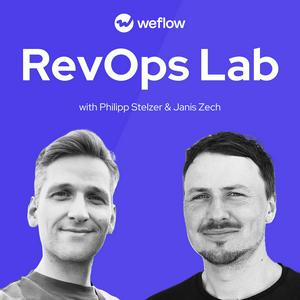
Welcome to the RevOps Lab - a podcast exploring the art & science of Revenue Operations.
Every week, Philipp & Janis host RevOps professionals to discuss best practices and lessons learnt building scalable revenue engines.
This show is for everyone interested in processes, tooling, enablement, and strategies to supercharge your GTM play.
To find more episodes and resources on scaling your revenue engine, visit getweflow.com/revops
Site de podcastOuça RevOps Lab, Market Makers e muitos outros podcasts de todo o mundo com o aplicativo o radio.net
Obtenha o aplicativo gratuito radio.net
- Guardar rádios e podcasts favoritos
- Transmissão via Wi-Fi ou Bluetooth
- Carplay & Android Audo compatìvel
- E ainda mais funções
Obtenha o aplicativo gratuito radio.net
- Guardar rádios e podcasts favoritos
- Transmissão via Wi-Fi ou Bluetooth
- Carplay & Android Audo compatìvel
- E ainda mais funções

RevOps Lab
Leia o código,
baixe o aplicativo,
ouça.
baixe o aplicativo,
ouça.
RevOps Lab: Podcast do grupo
 Brasil

