

Ouça este podcast gratuitamente no aplicativo: Baixe gratuitamente na App Store
radio.net
Sleeptimer
Guardar rádio
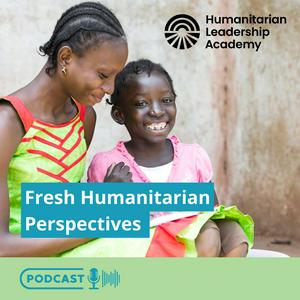
Fresh Humanitarian Perspectives
Humanitarian Leadership Academy
Último episódio
67 episódios
"Don't chase titles, chase competence": Finding purpose in humanitarian leadership
22/08/2026 | 59minSend us Fan Mail
"Your career is what you do. Your purpose is the difference you make along the way."
This conversation with Hyelladi Vandi uncovers many heart-felt truths drawn from Vandi's personal and professional journey as a humanitarian from Taraba state in Nigeria to Jigawa - from his building Taraba's first digital library during his national youth service year to problem-solving roles leading to Save the Children Nigeria.
Vandi through masterful storytelling shares key lessons on the importance of mentorship, humility, leadership through service, building competence despite hardship and creating real impact.
Visit the episode webpage to learn more:
Don't chase titles, chase competence: Finding purpose in humanitarian leadership
Thanks for listening. Please help us to grow this podcast by subscribing and leaving a review on the platform you're listening from. Thank you! For more resources for the humanitarian community, visit humanitarianleadershipacademy.org/resources
The views and opinions expressed in our podcast are those of the speakers and do not necessarily reflect the views or positions of their organisations.Exploring permaculture and regenerative humanitarian response
07/08/2026 | 1h 2minSend us Fan Mail
In conversation with Re-Alliance
Curious about permaculture practices and what regenerative humanitarian response looks like?
In this conversation, the HLA's Fay Loosley and Ka Man Parkinson connect with Re-Alliance's James Atherton (Permaculture Lead, Communication & Storytelling Lead) and Ansiima Casinga Rolande (Correspondent and Regenerative Settlements Storyteller) to find out more.
Tune in to learn about Re-Alliance’s work and mission and how environmentally and culturally grounded, regenerative strategies can be used to manage escalating crises, including climate and conflict displacement.
Personal stories: Hear how James and Rolande's personal journeys and lived experiences shape and guide their permaculture work and practices.
Concepts demystified: From sustainability to permaculture, learn what these mean and what they can look like in humanitarian response.
The case for regenerative approaches: Hear the economic case and 'co-benefits' of permaculture.
Localisation, strengthened: Discover how regenerative approaches ‘in place’ align with localisation and building resilient communities.
Scaling approaches: Hear more about the team's Kaya course and their vision for growing this knowledge across the sector.
Who this conversation is for
This conversation is for humanitarian practitioners and community-based responders, and those helping their own communities to thrive in challenging contexts. It is also for leaders in any humanitarian and development organisation who are interested in learning how they can adopt permaculture principles in policies and processes.
For show notes, speaker bios and conversation transcript, visit the podcast webpage:
www.humanitarianleadershipacademy.org/resources/exploring-permaculture-and-regenerative-humanitarian-response
Thanks for listening. Please help us to grow this podcast by subscribing and leaving a review on the platform you're listening from. Thank you! For more resources for the humanitarian community, visit humanitarianleadershipacademy.org/resources
The views and opinions expressed in our podcast are those of the speakers and do not necessarily reflect the views or positions of their organisations.From Policy to Practice: new funding and partnership models across Sudan
27/07/2026 | 49minSend us Fan Mail
What does real partnership look like in Sudan? The mutual aid response to the humanitarian crisis in Sudan offers a blueprint for rethinking humanitarian partnerships.
Bashair Ahmed, hosts this exploratory conversation with key actors in the Sudan response Safaa Dawoud, Taylor Dudley, and Federico Motka. The discussion analyses how Sudan's ongoing conflict has challenged conventional humanitarian responses and accelerated a shift towards locally led action.
Examining how local organisations, mutual aid groups and community volunteers became the first and most effective responders when international agencies were unable to access many parts of Sudan due to insecurity; the conversation delves into more of the following themes:
Mutual aid as the backbone of the response: how trusted community networks including Emergency Response Rooms (ERRs), volunteer groups and local organisations were already embedded within communities and could respond immediately while international actors faced significant access constraints.
Evolving to genuine partnership: challenging traditional humanitarian funding models and arguing that localisation should mean more than local implementation. Instead, local organisations should have direct access to funding, decision-making authority, flexible financing and long-term relationships with donors.
The evolving role of donors: how Vitol Foundation and Center for Disaster Philanthropy deliberately shifted more than 75% of their international humanitarian funding directly to local and national organisations.
Lessons from Sudan
The panel reflects on several important lessons including that supporting the wider ecosystem including local NGOs, community groups and diaspora networks is essential for sustainable humanitarian responses.
Visit the episode webpage for more information:
From Policy to Practice: new funding and partnership models across Sudan - Humanitarian Leadership Academy
Thanks for listening. Please help us to grow this podcast by subscribing and leaving a review on the platform you're listening from. Thank you! For more resources for the humanitarian community, visit humanitarianleadershipacademy.org/resources
The views and opinions expressed in our podcast are those of the speakers and do not necessarily reflect the views or positions of their organisations.Reflections from HX Abuja
13/07/2026 | 26minSend us Fan Mail
"It is in spaces like this we get inspiration, this is where we build networks, this is where we connect to others that ultimately translates to improvement for the lives of others because the networks that we build in these kinds of spaces help us to mobilise resources for instance, or co-create or plan together and it becomes improvement for people on the field or in the communities." - David Habba
On July 7 and 8, 2026, over 100 humanitarians from across Nigeria convened for Humanitarian Xchange Abuja. The room included technical experts, community organisations, researchers, local, national and international actors all responding to a broad spectrum of humanitarian crises in Nigeria from Adamawa to Zamfara.
"Nigeria, home to one of the world's largest populations, remains at the centre of many of these challenges. Yet it is also home to an extraordinary community of humanitarian actors committed to finding solutions and driving change.
That is why HX Abuja is so important.
The need for stronger coordination among humanitarian actors has never been greater. No single organisation can address the scale of today's challenges alone. When we coordinate effectively, we reduce duplication, use resources more efficiently, amplify local leadership, and ensure that assistance reaches those who need it most." - Duncan Harvey, Country Director Save the Children Nigeria
Some key topics covered at HX Abuja included localisation, access to data, innovation, humanitarian–development–peace Nexus, safety and security, shifting power, capacity sharing, stabilisation and peace, climate-migration nexus, youth leadership, advocacy and finance, accountability, safeguarding and more.
In this special episode of Fresh Humanitarian Perspectives, Nwando Okoh HLA Comms and Marketing Lead records live from #HXAbuja in conversation with truly inspiring HX Abuja participants Raquel Kasham Daniel, Maryam Hassan Gambo, Stephen Olushola Oladepo, David Habba, Dr Biobele Davidson, Rukaiya Ibrahim and Philip Ali Yidawi.
The 7 share their reflections on the first HX in Nigeria - from the conversations held to the expected impact on the collective response in Nigeria.
HX Abuja was organised by Save the Children Nigeria and Humanitarian Leadership Academy with support from Google.org
Learn more about the speakers here: https://www.humanitarianleadershipacademy.org/resources/reflections-from-hx-abuja/
Thanks for listening. Please help us to grow this podcast by subscribing and leaving a review on the platform you're listening from. Thank you! For more resources for the humanitarian community, visit humanitarianleadershipacademy.org/resources
The views and opinions expressed in our podcast are those of the speakers and do not necessarily reflect the views or positions of their organisations.Keeping communities at the heart of AI for humanitarians
02/07/2026 | 47minSend us Fan Mail
When we talk about co-designing humanitarian AI systems with communities, what does this look like in practice - and what happens when systems fail to address real world humanitarian complexities?
The HLA's Ka Man Parkinson sits down with three practitioners who have been an integral part of the HLA/Data Friendly Space humanitarian AI research and convening journey over the past year: Musaab Alhadi, Ali Al Mokdad and Nour Arab.
They explore tensions between humanitarian realities and the promise of new systems, while also looking at the exciting potential of AI in transforming humanitarian learning in the area of AI and beyond.
Tune in for a candid and honest conversation exploring:
People first: Why people, culture and communication must come before any AI system – and experiences of when there's been a disconnect
Beyond tech framing: Why ethical AI is a power discussion, not a technology discussion - and the sharp lessons learned from digital transformation the sector cannot afford to ignore
The humanitarian stress test: What operational realities in the ground in Sudan, Lebanon and beyond tell us about the limits of AI systems designed far from context
Beyond HQ: Why AI literacy for frontline responders and local leaders is critical - and what that means for the localisation agenda
Humanitarian AI learning now and in the future: Reflections on the new Ethical AI Kaya microlearning and imagining the future of AI-powered learning
Visit the episode webpage for a conversation transcript, speaker bios and links.
www.humanitarianleadershipacademy.org/resources/keeping-communities-at-the-heart-of-ai-for-humanitarians
Thanks for listening. Please help us to grow this podcast by subscribing and leaving a review on the platform you're listening from. Thank you! For more resources for the humanitarian community, visit humanitarianleadershipacademy.org/resources
The views and opinions expressed in our podcast are those of the speakers and do not necessarily reflect the views or positions of their organisations.
Mais podcasts de Negócios
 Market MakersInvestimentos, Negócios
 BraincastNegócios, Sociedade e cultura, Tecnologia
 Stock PickersInvestimentos, Negócios
 PrimoCastInvestimentos, Negócios
 G4 PodcastsGestão, Negócios
 ResumoCast | Livros para EmpreendedoresEmpreendedorismo, Negócios
 Os Sócios PodcastNegócios
 The Diary Of A CEO with Steven BartlettEnsino, Negócios, Sociedade e cultura
 Do Zero ao TopoNegócios
 Como Você Fez Isso?Negócios
Podcasts em tendência em Negócios
 Papo de Vendedor | VENDAS, Gestão e Liderança!Marketing, Negócios
 Masters of ScaleEmpreendedorismo, Gestão, Negócios
 BB PrivateNegócios
 MF CastEmpreendedorismo, Negócios
 McKinsey TalksGestão, Negócios
 O Investidor InteligenteInvestimentos, Negócios
 Café com ADM, by Leandro VieiraNegócios
 Investidor Sardinha por Raul SenaEmpreendedorismo, Negócios
 Papo ÍntimoNegócios
 Meio & MensagemMarketing, Negócios, Notícias, Novidades tecnológicas, Tecnologia
 O ConselhoEmpreendedorismo, Negócios
 Invista com TiagoNegócios
 Radar do InvestidorNegócios
 Odd LotsComentários de notícias, Investimentos, Negócios, Notícias
 CBN ProfessionalCarreiras, Negócios
 JKCastInvestimentos, Negócios
 Podcast Empresa Autogerenciável | EAG EducaçãoGestão, Negócios
 The Psychology of Money with Morgan HouselNegócios
 Future of MoneyEmpreendedorismo, Investimentos, Negócios
 Felipe Pereira | Consultoria AmbientalEmpreendedorismo, Negócios
Sobre Fresh Humanitarian Perspectives
Humanitarian conversations that inform, connect and inspire action.
Site de podcastOuça Fresh Humanitarian Perspectives, Market Makers e muitos outros podcasts de todo o mundo com o aplicativo o radio.net
Obtenha o aplicativo gratuito radio.net
- Guardar rádios e podcasts favoritos
- Transmissão via Wi-Fi ou Bluetooth
- Carplay & Android Audo compatìvel
- E ainda mais funções
Obtenha o aplicativo gratuito radio.net
- Guardar rádios e podcasts favoritos
- Transmissão via Wi-Fi ou Bluetooth
- Carplay & Android Audo compatìvel
- E ainda mais funções

Fresh Humanitarian Perspectives
Leia o código,
baixe o aplicativo,
ouça.
baixe o aplicativo,
ouça.
 Brasil