
Ouça este podcast gratuitamente no aplicativo: Baixe gratuitamente na App Store
radio.net
Sleeptimer
Guardar rádio
AI and the Future of Work: Artificial Intelligence in the Workplace, Business, Ethics, HR, and IT for AI Enthusiasts, Leaders and Academics
Dan Turchin
Último episódio
387 episódios
David Eagleman, Neuroscientist and Author, on the Brain as a Neural Parliament, AI Hallucinations, and Rethinking Democracy with AI
09/11/2026 | 41minSend us Fan Mail
David Eagleman is a world-renowned neuroscientist, New York Times bestselling author, and adjunct professor at Stanford University. He is the creator and host of the Emmy-nominated PBS documentary series The Brain, as well as the host of the top-ranking science podcast Inner Cosmos. After completing his undergraduate degree in literature, David earned his PhD in neuroscience and conducted postdoctoral research at the Salk Institute under Nobel laureate Francis Crick. A prolific neurotech entrepreneur, he co-founded Neosensory to pioneer sensory substitution wristbands for the deaf and hard of hearing, and has authored landmark books including Incognito and Livewired.
In this episode, David sits down with Dan for a special face-to-face conversation to examine why artificial neural networks simplified the cellular complexity of human neurons, how viewing the brain as a neural parliament explains cognitive decision-making, why the defensive activation theory reveals the evolutionary purpose of dreaming, and what the prospect of AI-driven governance means for the future of democracy.
In this conversation, we discuss:
Why AI’s success forced Eagleman to reconsider whether intelligence requires the biological complexity of the human brain.
What the brain’s continuous learning and competing internal drives suggest about the limits of LLMs and what might come next.
Why Eagleman connects AI hallucinations to creative hypothesis-making, and where testing those ideas makes the difference.
His case for an AI president, how citizen-specific agents might represent voters, and why transparency and explainability would be essential.
His hypothesis that dreams defend the brain’s visual territory, and how sensory substitution lets deaf users interpret sound through touch.
Why understanding consciousness remains an open scientific challenge, and how Eagleman hopes AI could accelerate answers to neuroscience’s toughest questions
Explore the conversation
00:00 Show intro and a special face-to-face episode
01:23 Meet Dr. David Eagleman, neuroscientist and author
02:50 From books in New Mexico to neuroscience: Eagleman's backstory
03:47 Can we engineer a brain? Neurons, neural networks, and LLMs
08:48 Continuous learning: how the brain differs from an LLM
10:25 Is recall intelligence? Remixing ideas and AI hallucinations
12:14 Beyond LLMs: the brain as a team of rivals and a neural parliament
17:37 A trillion dollars of compute: is brute force the best path to intelligence?
19:18 Studying with Francis Crick at the Salk Institute
20:23 Should AI help us lead or lead us? The case for an AI president
26:27 Who controls an AI leader? Open source, explainability, and Taylor Swift
29:04 Why we dream: defending the visual cortex from takeover
32:39 Brain plasticity and sensory substitution for the deaf
34:15 A prediction for 2036: at the foot of the mountain
36:12 Consciousness: the biggest open question in neuroscience
38:07 The ten unsolved questions of neuroscience
39:45 How AI could speed up science, and a mid-decade check-in
41:06 Where to find David Eagleman
Resources:
Subscribe to the AI & The Future of Work Newsletter
Connect with David on LinkedIn
Further reading: David Eagleman’s tribute to his mentor, “Remembering a trail blazer – Francis Crick”.
Other episode mentioned: on Why Stacking Tools Around an LLM Won't Get Us to AGI with Dr. Ben Goertzel, SingularityNET CEO and BGI Labs Founder
-
Pick up a copy of The AI Playbook: Mastering the Rare Art of Machine Learning Deployment by Dr. Eric Siegel, featuring a six-step framework for taking predictive AI initiatives from concept to deployment. Get your copy at https://bizml.com/SE 32: The Work of Reinventing Work Is Just Getting Started, with Leaders from Workday and OneDigital | Live from Workday Rising 2026
05/11/2026 | 21minSend us Fan Mail
At Workday Rising 2026 in Las Vegas, we joined the Workday executive team and customer community to discuss Workday's vision for AI and the future of work. We went beyond the headlines to understand how one of the world's leading HR tech companies is going through a "re-founding" moment, as co-founder Aneel Bhusri returns as CEO for a second stint at the helm.
In this special compilation episode of AI and the Future of Work, we bring you three conversations recorded live at Workday Rising 2026. This is the first episode of our four-part Workday Rising series.
John Bruce, VP of People Innovation and Technology at OneDigital, shares how his company is putting AI agents to work, from one that gives managers insights about their teams to ACE, a general "coworker" employees go to with their questions. Max Wessel, SVP of Product at Workday, shares how his team decides what to build and the origin story behind the event's big product announcements. Gerrit Kazmaier, President of Product and Technology at Workday, shares Workday's vision for using AI to restore humanness to work.
All three leaders explain why the work of reinventing work is just getting started.
Featured Guests
John Bruce, VP of People Innovation and Technology at OneDigital.
Max Wessel, SVP of Product at Workday.
Gerrit Kazmaier, President of Product and Technology at Workday.
In the coming weeks we will release each of these conversations in full. As each episode goes live, we will add the link here.
What You'll Learn
Why OneDigital calls its AI agents coworkers, how each one grows from intern to apprentice to coworker, and which moments, like onboarding, may still belong in Workday itself
Why John's team has to teach its agents to push back, and the human skill he hopes AI can't replace: the curiosity to find the real problem
What it means to run Workday like "the world's largest startup," and why taste and judgment matter when it's easy to generate code
What generative UI means, and why agents still need forms and charts that feel familiar to the people using them
Why nobody comes home proud of answering 50 emails, and how companies can decide what AI should do, what it can augment, and what should stay innately human
The future Gerrit hopes for five years from now, and the "bandwidth tax" that keeps so many people from focusing on the work that inspires them
Inspired by something you heard in this episode?
Share your favorite insight about how work is being reinvented, and tag us on social.
And don't forget to subscribe to AI and the Future of Work for more conversations with the leaders shaping the future of work.
Other special episodes:
SE 28: They Might Be Agentic, But We Have Agency: Leaders from Upwork, Axonis, and John Hancock on Where the Human Belongs (Live from Ai4 2026)
SE 26: Designing AI for Accountability and Harmony with Leaders from Honeycomb, FieldAI, Archetype AI, and Zoom (Live from HumanX 2026 Special Episode)
SE 27: AI and the Next Generation: What We Can Learn from Them (International Youth Day Special Episode)
SE 19: AI and Education: How Artificial Intelligence Is Transforming Learning (International Day of Education Special Episode)
Lessons from Four Unicorn CEOs Disrupting Massive Markets with AI (Special Episode)
Ethical AI in Hiring: How to Stay Compliant While Building a Fairer Future of Work (HR Day Special Episode)
AI and Safety: How Responsible Tech Leaders Build Trustworthy Systems (National Safety Month Special)
Lessons from Leaders: How AI Is Redefining Work and the Human Experience (Labor Day Special Episode)412: Rahul Vohra, Head of Superhuman Mail: From Onboarding Users by Hand to an AI-Native Productivity Suite
02/11/2026 | 50minSend us Fan Mail
Rahul Vohra is Head of Superhuman Mail and the founder of the email app formerly known as Superhuman, which he led as CEO until its 2025 acquisition by Grammarly. Grammarly has since taken the Superhuman name, and the combined company is building an AI-native productivity suite across Superhuman Mail, Grammarly, Coda, and Superhuman Go to transform enterprise workflows across millions of users and over 50,000 organizations.
A computer scientist and serial entrepreneur, Rahul studied at Cambridge University before launching Rapportive, the first Gmail plug-in to scale to millions of users, which he sold to LinkedIn in 2012. He is also a prominent angel investor whose fund has invested $50 million in more than 120 companies, including Supabase, Mercury, Writer, Placer.ai, and ClassDojo.
In this episode, Rahul draws on more than a decade of building products and a front-row seat to the AI era, to ask whether more capable software leaves humans with less work or far more of it.
In this conversation, we discuss:
Why relying on traditional product launches leads to unsustainable churn, and how white-glove 1-on-1 onboarding builds a feedback loop that achieves product-market fit.
How measuring the percentage of users who would be "very disappointed" without a product provides an actionable engine for writing customer-centric roadmaps.
What Jevons' Paradox reveals about how AI automation surges overall market demand for software engineers, lawyers, and customer support practitioners.
Why the collapse of software development costs shifts long-term startup defensibility from writing code to cultivating taste, restraint, and distribution.
How uniting email, writing, and workspace tools into a proactive AI companion eliminates administrative friction while amplifying human creativity.
What executive advice for professionals facing technological disruption emphasizes about asserting personal agency to become truly AI-native.
Explore the conversation
00:00 Show intro and listener shoutout
02:06 Meet Rahul Vohra, Head of Superhuman Mail
03:21 From Cambridge and Rapportive to an AI-native productivity suite
05:26 Superhuman onboarding and early user feedback
08:44 In-person onboarding, charging from day one, and fixing every bug
11:47 Scaling the Superhuman onboarding into a go-to-market motion
15:02 What product-market fit really means: Graham, Altman, and Andreessen
18:24 The Sean Ellis test and the 40% very disappointed benchmark
20:40 How Rahul chose email as the problem to solve
25:40 Picking a startup problem in the AI era: market, taste, and distribution
28:30 What is easier and harder about building a startup today
29:46 Taste and restraint: the Burbn to Instagram story
30:52 Competition, distribution, and the incumbent advantage
32:00 Human uniqueness and a balanced relationship with AI
36:01 Jevons paradox and AI's impact on jobs
38:28 Coding agents, software engineers, and legal work
40:40 Customer support hiring in the age of AI
42:45 A prediction for 2036
44:57 Advice for workers who feel destabilized by AI
48:57 An invite for part two and where to find Rahul Vohra
Resources
Subscribe to the AI & The Future of Work Newsletter
Connect with Rahul on LinkedIn
First Round Review landmark essay: How Superhuman Built an Engine to Find Product Market Fit
On How AI Anxiety, Burnout, and Building Trust in the Workplace
-
Help your team turn AI tools into everyday skills with Guild AI Academy. Learn more at guild.com/ai411: Jeremy Burton, GM of Observability at Snowflake: The Data Layer Was Never a Commodity. It’s the Whole Game
26/10/2026 | 44minSend us Fan Mail
Jeremy Burton is the General Manager for Observability Business Unit at Snowflake following the acquisition of Observe, the developer-centric observability platform where he served as CEO. A veteran enterprise technology executive with a thirty-year career spanning Silicon Valley, Jeremy previously served as Executive Vice President of Marketing and Corporate Development at Dell, President of Products at EMC, and CEO of Serena Software, with earlier leadership roles at Symantec, Veritas, and Oracle. He has served on Snowflake’s board of directors since 2015 and sits on the McLaren Racing Advisory Board.
In this episode, Jeremy draws on watching customers go from collecting a petabyte of data in a decade to generating one every two days to make the case that without a real data foundation, enterprises will either get the wrong answer from their AI, or burn a fortune getting to the right one.
In this conversation, we discuss:
Why pointing AI agents at hundreds of terabytes of telemetry burns tokens fast, and what Jeremy says has to change first.
How an AI agent facing 10 sources of truth can deliver the wrong answer with total confidence.
Why Jeremy calls the LLM “a new animal in the zoo,” and what that means for anyone trying to monitor AI agents.
How AI agents are starting to build the knowledge graphs that once took human implementation teams to create.
Why evals are becoming essential to running an LLM, and what a single model release can do to existing applications.
What Jeremy would tell his younger self stepping off the plane to meet Mark Benioff, and the career superpower he undervalued.
Explore the conversation:
00:00 Intro and AI Fun Fact: Pope Leo XIV's Encyclical and Anthropic's Vatican Address
04:08 Introducing Jeremy Burton, GM for Observability at Snowflake and Former CEO of Observe
07:09 The Observe Origin: Pitching Observability as a Unified Data Problem Natively on Snowflake
10:20 Observability as a Data Problem: Metrics, Logs and Traces
13:39 Snowflake Culture and Leadership Eras
16:58 Joining Snowflake: Running Observe After the Acquisition
18:57 Data Foundation vs. Frontier Models: Balancing CPU and GPU Burn with Context
22:23 Snowflake's AI Strategy: Data Foundation and Sources of Truth
28:11 Non-Human AI Telemetry: Using Knowledge Graphs to Structure Machine Data
32:31 Probabilistic AI and LLM Observability: Why Evals and Harnesses Are Essential
36:14 Future of Work: The "LLM as Modern-Day Tractor" and Software Engineering Practices
41:18 Career Superpowers: The Value of Networks and Relationships in Silicon Valley
43:06 Closing: Where to Connect with Jeremy Burton and Explore Snowflake Observability
Resources:
Subscribe to the AI & The Future of Work Newsletter
Connect with Jeremy Burton on LinkedIn
AI fun fact article
On How Ashu Garg, General Partner at Foundation Capital, finds and invests in the future of AI
Other episodes mentioned on the show: Automate the Work, Amplify the Humanity, with Snowflake's CPO Arnnon Geshuri
-
Learn how Box connects secure enterprise content with AI to power smarter workflows. Visit box.com/ai to learn more.410: Johanna Jackman, Chief People Officer at Freshworks: Responsible AI Isn’t Slow. It’s Bold, With Human Judgment
19/10/2026 | 47minSend us Fan Mail
Johanna "JJ" Jackman is the Chief People Officer at Freshworks, the global cloud-based customer service and IT service management platform serving over 75,000 corporate clients worldwide. With an international career across six countries, JJ began her professional journey in the Australian mining industry before transitioning into high-growth technology.
Prior to joining Freshworks in 2023, she served as Chief People Officer at Airtable, Chief Human Resources Officer at Pure Storage, and Vice President of HR at LinkedIn during its formative scaling era, and currently sits on the Board of Directors at Grafana Labs.
In this episode, JJ sits down with Dan to discuss why modern employee experience requires transitioning from traditional organizational charts to workflow-centric platforms, how HR functions as Customer Zero to eliminate operational friction across enterprise IT and HR services, why executive leaders must share responsibility with employees for continuous AI fluency, and how the convergence of human judgment with digital teammates is redefining workforce planning and career mobility.
In this conversation, we discuss:
Why evaluating enterprise software transformation requires abandoning rigid organizational charts in favor of end-to-end, workflow-centric employee experiences.
How serving as "Customer Zero" allows internal people teams to co-design IT and HR service platforms that eliminate administrative friction for global workforces.
What the creation of dedicated AI enablement roles reveals about shifting corporate strategy from traditional headcount planning to dynamic capability modeling.
Why fostering organizational resilience requires a mutual commitment between employers and workers to maintain continuous AI fluency and career relevance.
How enterprise leaders can establish transparent guardrails to ensure autonomous algorithms inform decision-making without supplanting human judgment.
What a data-driven, structured job search framework teaches early-career professionals about asserting personal agency in an algorithmically filtered hiring market.
Explore The Conversation
00:00 Intro and listener mailbag: Allison in Trenton on special episode 21 and WEF global job trends
02:35 Introducing Johanna "JJ" Jackman, Chief People Officer at Freshworks
04:09 From mining underground to tech executive: Formative lessons in human-centric leadership
06:22 The Freshworks culture trifecta: Manager support, peer collaboration, and goal clarity
08:47 From org charts to workflows: Framing "People Platform as a Service" with IT leadership
12:08 HR as customer zero: Streamlining Lives HR and eliminating friction across the employee journey
15:32 Rewriting the employment contract: Executive role-modeling and shared AI fluency
21:45 Capacity over headcount: "AI in Motion" days and hiring an AI enablement leader
29:48 Responsible AI in HR: Safeguarding human judgment in promotion and performance decisions
33:34 Empowering early-career professionals: Agency, unlearning, and Josh's mathematical job hunt
41:52 The 2031 vision: Digital employee IDs, merging CPO-CIO roles, and remote leadership
45:01 Closing: Where to connect with Johanna "JJ" Jackman and explore Freshworks
Resources:
Subscribe to the AI & The Future of Work Newsletter
Connect with Johanna "JJ" Jackman on LinkedIn
Other episodes and research mentioned on the show:Special Episode 21 featuring Charlene Li, Daphne Jones, Patty Hatter, Mona Sabet, and Tess Posner on female leadership in AI
-
See why Freshworks was named a Leader in the 2026 Gartner® Magic Quadrant™ for ITSM. Learn more → freshworks.com/dant
Mais podcasts de Empreendedorismo


Podcasts em tendência em Empreendedorismo







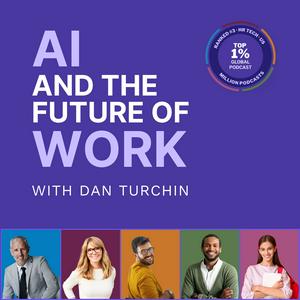
Sobre AI and the Future of Work: Artificial Intelligence in the Workplace, Business, Ethics, HR, and IT for AI Enthusiasts, Leaders and Academics
🏆 Ranked #3, Best Tech Podcasts — Million Podcasts (2026) | Top 1% global podcast. 450+ episodes. 10M+ downloads. Host Dan Turchin, PeopleReign CEO, explores how AI is changing the workplace. He interviews thought leaders and technologists from industry and academia who share their experiences and insights about artificial intelligence and what it means to be human in the era of AI-driven automation. Learn more about PeopleReign, the system of intelligence for IT and HR employee service: http://www.peoplereign.io.
Site de podcastOuça AI and the Future of Work: Artificial Intelligence in the Workplace, Business, Ethics, HR, and IT for AI Enthusiasts, Leaders and Academics, Kritikê Podcast e muitos outros podcasts de todo o mundo com o aplicativo o radio.net
Obtenha o aplicativo gratuito radio.net
- Guardar rádios e podcasts favoritos
- Transmissão via Wi-Fi ou Bluetooth
- Carplay & Android Audo compatìvel
- E ainda mais funções
Obtenha o aplicativo gratuito radio.net
- Guardar rádios e podcasts favoritos
- Transmissão via Wi-Fi ou Bluetooth
- Carplay & Android Audo compatìvel
- E ainda mais funções

AI and the Future of Work: Artificial Intelligence in the Workplace, Business, Ethics, HR, and IT for AI Enthusiasts, Leaders and Academics
Leia o código,
baixe o aplicativo,
ouça.
baixe o aplicativo,
ouça.
AI and the Future of Work: Artificial Intelligence in the Workplace, Business, Ethics, HR, and IT for AI Enthusiasts, Leaders and Academics: Podcast do grupo
 Brasil

