PodcastsSaúde e fitnessHypertrophy Past and Present

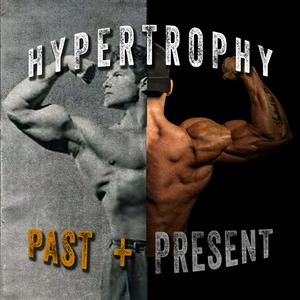
Hypertrophy Past and Present

Chris Beardsley and Jake Doleschal
Hypertrophy Past and Present
Último episódio

41 episódios

  • Hypertrophy Past and Present

    041 New study shows twice as much volume doesn't cause extra muscle growth

    02/03/2026 | 55min
    In this episode of Hypertrophy Past & Present, Jake and Chris dive into whether more volume is always better. The episode opens in the late Silver Era with Sergio Oliva’s high-volume split, then pivots into a brand-new study that compares “high” vs “super high” volumes in trained lifters. 
    Key topics include:
    Sergio Oliva’s late-Silver Era routine 
    New study 18 vs ~32 sets per week
    Why “more volume” didn’t produce more hypertrophy
    Damage as “resource drain” vs damage as fatigue
    No fascicle length changes in trained lifters (and what that implies about sarcomerogenesis)
    Practical programming tip, reframing “rest days” as repair days
  • Hypertrophy Past and Present

    040 This new study will change how you think about fatigue

    23/02/2026 | 1h 25min
    In this episode of Hypertrophy Past & Present, Jake and Chris unpack a new hypertrophy study that illustrates how fatigue doesn’t just make training harder but can directly reduce the hypertrophic stimulus by lowering single-fibre mechanical tension. The episode opens in the Silver Era again with Henry Paschal’s 1950 “busy person” program then pivots into the core discussion: why fatigue mechanisms (CNS and calcium-ion related) dampen muscle growth, and what this implies for exercise order, rep ranges, and advanced training methods. 
    Key topics include:
    Henry Paschal’s 1950 routine
    A new “repetition duration” study
    How CNS fatigue and calcium-ion fatigue both serve the same function
    Why max effort and slow velocity don’t always equal max recruitment and max tension
    Programming implications: exercise order, rep ranges, RIR, clusters, and isometrics
  • Hypertrophy Past and Present

    039 How to instantly increase your strength (through motivational techniques)

    16/02/2026 | 1h 17min
    In this episode of Hypertrophy Past & Present, Jake and Chris break down how you can become stronger immediately - not by changing your program, but by changing your motivation. The conversation starts in the Silver Era again, comparing Clarence Ross’ 1949/50 routine to his 1952 “favourite routine”, and why the small adjustments he made make physiological sense. From there, Chris connects motivation to motor unit recruitment through Marcora’s Psychobiological Model of Fatigue.
    Key topics include:
    Clarence Ross’ 1949/50 vs 1952 routine: what changed and why it matters
    How motivation can increase strength right now via higher voluntary activation / recruitment
    Practical ways to boost motivation
    How cognitive fatigue reduces performance and how to mitigate it in the gym
    Whether or not you can “stack” motivation tools
  • Hypertrophy Past and Present

    038 Periodisation for hypertrophy is pointless (unless you do this)

    09/02/2026 | 1h 7min
    In this episode of Hypertrophy Past & Present, Jake and Chris unpack periodisation for hypertrophy, including what it actually is (and isn’t), why most “periodised” bodybuilding programs end up adding complexity without adding results, and which variables you can change over time without accidentally driving atrophy or accumulating a fatigue debt. The episode opens in 1952 with Clarence Ross’ pre-steroid full-body AAA “favourite routine”. From there, Jake and Chris break down the three main variables people try to periodise in hypertrophy training: volume, rep range, and exercise selection.
    Key topics include:
    -Why Clarence Ross’ 1952 full-body plan is a great 'non periodised' template
    -What is training 'periodisation'
    -The 3 variables people periodise for hypertrophy: volume, rep range, exercise selection
    -Why escalating volume blocks can reduce stimulus
    -Why light-load blocks for 'capillarisation' doesn't potentiate future hypertrophy
    -The only phase potentiation effect that really makes sense for hypertrophy
  • Hypertrophy Past and Present

    037 How to grow muscle only training once per week

    02/02/2026 | 1h 10min
    In this episode of Hypertrophy Past & Present, Jake and Chris tackle a surprisingly common question: what if you can only train once per week? Beginning with an early-1960s two-way split from John McCallum to discuss exercise sequencing, why multi-joint lifts paired with single-joint “finishers” can preserve recruitment better than simply adding more straight sets, and what older routines got right (and missed) due to equipment constraints. The episode then breaks down why once-weekly training is uniquely difficult for hypertrophy, how maintenance literature informs minimum set targets, and what a realistic once-per-week template actually looks like.
    Key topics include:
    -John McCallum's silver era two-way split and how we would modify it today
    -Why very high reps don't cause the same muscle growth as moderate reps
    -Training once per week: when it’s a real constraint vs avoidable
    -Why every 5 days is a massive upgrade over every 7
    -Different once per week program ideas
    -Posing as a mid-week stimulus

Mais podcasts de Saúde e fitness

Sobre Hypertrophy Past and Present

A deep dive into the science of muscle growth. Hosted by Chris Beardsley and Jake Doleschal, this podcast explores hypertrophy training through the lens of pre-steroid era bodybuilding and modern muscle physiology.
Site de podcast

Ouça Hypertrophy Past and Present, Relaxing White Noise e muitos outros podcasts de todo o mundo com o aplicativo o radio.net

Obtenha o aplicativo gratuito radio.net

  • Guardar rádios e podcasts favoritos
  • Transmissão via Wi-Fi ou Bluetooth
  • Carplay & Android Audo compatìvel
  • E ainda mais funções
Informação legal
Aplicações
Social
v8.7.2 | © 2007-2026 radio.de GmbH
Generated: 3/5/2026 - 4:57:08 AM